
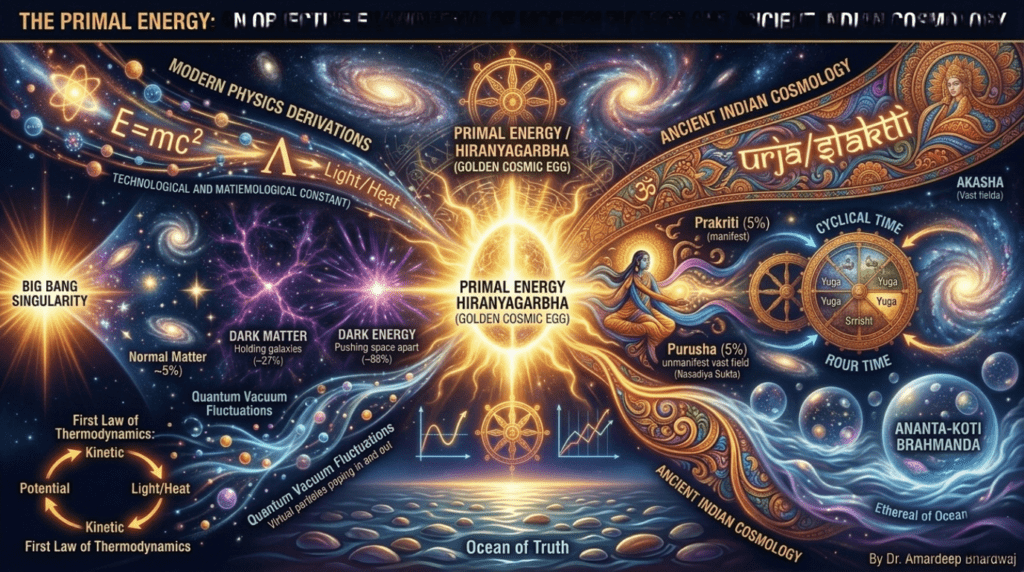
The Primal Energy of the Universe: Two Scientific Perspectives, 3500 Years Apart
This articles objectively examines the idea of a “primal energy” – from which all other
energies flow – through the lens of modern physics and compares it with the
scientific derivations of ancient India, 3500 years ago. In science we don’t invoke
gods, but we do study fundamental energies, but the deeper we go into science the
closer we seem to come to the concepts of God. The idea of an overarching,
supreme and primal energy is one such powerful concept.
Take the First Law of Thermodynamics – energy conservation – to begin with. A
cornerstone of modern physics, the law informs us that “energy cannot be created or
destroyed, it can only be transformed from one form to another”. In other words, the
total energy is constant in an isolated system; it simply changes form (like kinetic to
potential energy, or light to heat). If there was indeed a single “root source” of
energy at the time the universe, or multiverse, was formed; the law would interpret it
as a primal energy of the universe which was originally in one form only and later
diversified into other forms, including a form called ‘matter’.
Indeed, in Einstein’s theory of relativity, the mass (m) of any matter and energy (e)
are equivalent under certain conditions, such as the mass moving at the speed of
light, squared. Hence, E=mc². It reveals that mass and energy are interchangeable
and inter-convertible under certain conditions. It is very likely that such conditions
were met when the universe was forming, and are still being met as new galaxies
emerge or decay. Further, there is no dearth of modern scientific evidence to show
that mass and energy are inter-converting in these mammoth inter-galactic
churnings. Since a small amount of mass can be converted into a massive amount
of energy, mass can be viewed as “congealed” or compressed and stored energy.
Einstein’s equation shows they are indeed different forms of the same thing. As to
the question, which came first, mass or energy, the overwhelming majority of global
scientific opinion favours energy as the fore-runner.
Surprisingly, these modern scientific derivations are no different to the ancient Indian
descriptions of ‘Urja’ or ‘Shakti’, both of which mean ‘energy’; and ‘Akasha’ or the
fundamental field from which all matter, hence mass, arises. Ancient Indian scientific
treatises clearly state that the sum total of ‘Urja’ and ‘Akasha’ is constant, that
neither can ever be destroyed, though each can convert to the other’s forms under
certain conditions. Just this one commonality of ancient Indian and Einstein’s
derivations, 3500 years later, is stunningly similar. But there is a lot more, ancient
Indian scientific thought throws up a whole array of such universal derivations, which
modern science seems to increasingly corroborate as it advances further.
Types of Energies and Matter in the Cosmos
An AI grab from the internet states that the general understanding today is that the
cosmos is dominated by three primary components: Dark Energy (~68%), which
accelerates expansion; Dark Matter (~27%), which provides gravitational cohesion;
and Normal Matter/Energy (~5%), including stars, gas, and radiation. These
components manifest through various forms, including gravitational, nuclear, radiant,
and kinetic energy, shaping the universe’s structure and evolution. Since dark matter
and dark energy cannot be seen or scientifically recorded, it shows that the
observable universe is only about 5%, a small fraction of the unobservable or dark
universe. Make a note of this since it will come up for discussion a bit later in this
article.
To be clear, Dark Matter often causes confusion because of its name. Dark Matter is
not a dark color, rather, it is called “dark” because it is invisible to us since it does not
absorb, reflect, or emit any light. Dark matter is a mysterious type of matter that
holds galaxies together. Similarly, Dark Energy is the name scientists have given to
whatever is causing our universe to expand at an accelerating rate over time
another cosmic mystery. Dark energy is not concentrated in galaxies or galaxy
clusters, instead scientists think it’s spread throughout the universe. Both dark
matter and dark energy remain cosmic mysteries even today, baffling scientists,
posing deep, unanswered questions about the universe.
Relevant to this, here are some interesting definitions from NASA:
(a) Cosmic Dark Energy: An unknown form of energy that fills space, acting as a
"repulsive gravity" that drives the accelerated expansion of the universe. It is
hypothesized to be a cosmological constant or a field known as quintessence.
(b) Gravitational Energy: The potential energy associated with the gravitational
field, which pulls matter together, forming stars and galaxies, and balances the
expansion.
(c) Radiant Energy: Energy in the form of electromagnetic waves (light, X-rays,
gamma rays) emitted by stars, quasars, and supernovae.
(d) Nuclear Energy: Potential energy binding protons and neutrons in the atomic
nucleus, released through fusion in stars or fission, providing the heat and light for
stars like our Sun.
(e) Kinetic Energy: Energy of motion, seen in revolving galaxies, orbiting planets,
and high-speed particles like cosmic rays.
(f) Rest Mass Energy: The energy inherent in matter itself, as described by
Einstein’s E=mc².
(g) Thermal Energy: Heat generated by moving molecules, vital for regulating
temperatures in the universe.
(h) Universe Normal Matter (5%): Protons, neutrons, and electrons forming stars,
planets, and gas.
(i) Dark Matter (27%): Invisible matter that does not interact with light but holds
galaxies together via gravity.
(j) Dark Energy (68%): Pushes the universe apart.
Let it be clear that the above is a mere representative, not a complete, listing of all
energy or matter types. Further, all the existing energies interact with each other in
myriad ways and also interact with all forms of matter in other ways. Imagine the
infinite scope to learn about the secrets of the universe! No wonder that Sir Isaac
Newton, the great scientist, famously described his entire life’s scientific work by
saying he felt like a boy playing on the seashore, finding smoother pebbles or
prettier shells than ordinary, while the vast ocean of truth; remained undiscovered
before him; thereby highlighting the vastness of knowledge ye to be uncovered.
Types of Energies and Matter in the Cosmos
An AI grab from the internet states that the general understanding today is that the
cosmos is dominated by three primary components: Dark Energy (~68%), which
accelerates expansion; Dark Matter (~27%), which provides gravitational cohesion;
and Normal Matter/Energy (~5%), including stars, gas, and radiation. These
components manifest through various forms, including gravitational, nuclear, radiant,
and kinetic energy, shaping the universe’s structure and evolution. Since dark matter
and dark energy cannot be seen or scientifically recorded, it shows that the
observable universe is only about 5%, a small fraction of the unobservable or dark
– universe. Make a note of this since it will come up for discussion a bit later in this
article.
To be clear, Dark Matter often causes confusion because of its name. Dark Matter is
not a dark color, rather, it’s called “dark” because it’s invisible to us since it doesn’t
absorb, reflect, or emit any light. Dark matter is a mysterious type of matter that
holds galaxies together. Similarly, Dark Energy is the name scientists have given to
whatever is causing our universe to expand at an accelerating rate over time —
another cosmic mystery. Dark energy isn’t concentrated in galaxies or galaxy
clusters, instead scientists think it’s spread throughout the universe. Both dark
matter and dark energy remain cosmic mysteries even today, baffling scientists,
posing deep, unanswered questions about the universe.
Relevant to this, here are some interesting definitions from NASA:
(a) Cosmic Dark Energy: An unknown form of energy that fills space, acting as a
“repulsive gravity” that drives the accelerated expansion of the universe. It is
hypothesized to be a cosmological constant or a field known as quintessence.
(b) Gravitational Energy: The potential energy associated with the gravitational
field, which pulls matter together, forming stars and galaxies, and balances the
expansion.
(c) Radiant Energy: Energy in the form of electromagnetic waves (light, X-rays,
gamma rays) emitted by stars, quasars, and supernovae.
(d) Nuclear Energy: Potential energy binding protons and neutrons in the atomic
nucleus, released through fusion in stars or fission, providing the heat and light for
stars like our Sun.
(e) Kinetic Energy: Energy of motion, seen in revolving galaxies, orbiting planets,
and high-speed particles like cosmic rays.
(f) Rest Mass Energy: The energy inherent in matter itself, as described by
Einstein’s E=mc^2.
(g) Thermal Energy: Heat generated by moving molecules, vital for regulating
temperatures in the universe.
(h) Universe Normal Matter (5%): Protons, neutrons, and electrons forming stars,
planets, and gas.
(i) Dark Matter (27%): Invisible matter that does not interact with light but holds
galaxies together via gravity.
(j) Dark Energy (68%): Pushes the universe apart.
Let it be clear that the above is a mere representative, not a complete, listing of all
energy or matter types. Further, all the existing energies interact with each other in
myriad ways and also interact with all forms of matter in other ways. Imagine the
infinite scope to learn about the secrets of the universe! No wonder that Sir Isaac
Newton, the great scientist, famously described his entire life’s scientific work by
saying he felt like a boy playing on the seashore, finding smoother pebbles or
prettier shells than ordinary, while the vast "ocean of truth" remained undiscovered
before him; thereby highlighting the vastness of knowledge ye to be uncovered.
The Big Bang: Universe’s Energetic Birth
What about the origin of that initial energy? One of the theories,
remember it’s still a theory, is the Big Bang Theory. It
tells us that the universe began in an extremely hot, dense, highly energised state.
As we trace history backwards, space and time collapse to a tiny volume and the
energy density skyrockets. In fact, theoretical extrapolations suggest that as time
approaches zero (the moment of the Big Bang), volumes shrink to zero and the
energy density grows without limit – formally becoming a singularity. This indicates
that our current laws of physics and general relativity break down and can’t describe
the very “beginning.” Physicists believe that in the first fractions of a second after the
Big Bang, the known forces (gravity, electromagnetism, and the nuclear forces) were
unified, and a tremendous amount of energy was released. Over billions of years, as
the universe expanded and cooled, these energies (including radiation such as light,
high-energy particles and potential energy in fields) slowed down as they moved
across many aeons of time in space and eventually, after they slowed to a certain
threshold – possibly falling below the speed of light squared – matter, or mass,
began to form.
Ancient Indian Scientific Parallels
Ancient Indian science, largely derived from Vedic, Puranic, and Samkhya
philosophies, views the universe's birth as a cyclical, divine, and energetic process
rather than a singular event. Key concepts include the Hiranyagarbha (golden
cosmic egg), the cyclical time of Srishti (creation) and Pralaya (dissolution), and the
concept of Ananta-Koti Brahmanda (multiverse).
Hiranyagarbha (Golden Egg): The Rigveda (10.121) describes a golden egg or
radiant womb as the source from which the universe was born.
Cyclical Time: The universe is not considered to have a single beginning or end. It
passes through endless cycles of birth, growth, and destruction. One day of
Brahma lasts billions of human years, followed by a night of equal length.
Brahmanda (Cosmic Egg): The Brahmanda Purana explains that the entire universe
emerged from this cosmic egg, which was filled with divine energy and matured over
time.
Samkhya Perspective: The Samkhya school suggests the universe emerged from
the interaction of Purusha (consciousness) and Prakriti (matter), forming an embryo
that developed into the world.
Nasadiya Sukta (Cosmic Origins): The Rigvedic hymn, Nasadiya Sukta (10.129),
questions the origins, suggesting that in the beginning, there was neither existence
nor non-existence, only a primordial seed born of desire and consciousness.
Multiverse and Vibrations: The Bhagavatam describes the creation of countless
bubble-like universes, arising from the breathing fluctuations of Lord Vishnu.
It is interesting that these ancient derivations have modern scientific parallels, such
as:
Cyclical Model: The Hindu concept of endless creation and dissolution cycles shares
similarities with modern theories like Roger Penrose’s Conformal Cyclic Cosmology.
Vacuum Fluctuation: The idea of universes arising from nothingness or a causal
ocean in the Bhagavatam resonates with modern vacuum fluctuation theories.
Orderly Universe: Ancient texts describe the early universe as highly ordered, similar
to observations regarding the low entropy of the early universe in modern physics.
To sum up this part, it appears that the cooling and slowing cosmic energies gave
birth to matter, be it solid, liquid, gas or any intermediate state in-between. The
universe’s total energy content – in all its varied forms – as well as its entire matter
content, originated from that primordial unified energy field.
Quantum Vacuum: Energy in “Empty” Space
In quantum physics, even the notion of emptiness hides a restless energy. This
corresponds directly, and almost exactly, to the ancient Indian concept of ‘Purusha’
or that which is as yet unmanifest. Purusha can be said to be comprised of energies,
hence is not empty but seething with unmanifested energy or energies. The Purusha
Sukta describes the cosmos as arising from the sacrifice of this cosmic Purusha,
representing the transition from the unmanifest to the manifest.
Similarly, the ‘quantum vacuum’ of today sees the vastness of the universe as not
empty but a seething field of virtual particles and fluctuations; just like the ancient
Indian ‘Purusha’. As one expert explains, “Zero-point energy refers to random
quantum fluctuations of the … fields that are present everywhere in the vacuum; in
other words, an ‘empty’ vacuum is actually a seething cauldron of energy. This
energy is present even at absolute zero temperature when no matter is present.”.
These ‘vacuum fluctuations’ are a direct consequence of the Heisenberg
uncertainty principle: you cannot have exactly zero energy, because particles and
fields always have some residual “jitter.” In practical terms, this manifests in tiny but
real effects like the Casimir force between uncharged plates.
Mathematically, we can picture the vacuum as the lowest-energy state of all
quantum fields. But quantum theory tells us that there is no true zero-energy state.
Even a so -called perfect vacuum has structure and fluctuations. Because
of these fluctuations, the vacuum energy can occasionally convert into real
particles (and then annihilate back).
This is a partial explanation of the fact that the tiniest sub-
atomic entities, like electrons for example, behave both like waves of energy and particles
of matter at the same instant. In fact, Einstein’s famous equation, E=mc², also shows that an energy fluctuation of the vacuum can produce a particle–anti-particle pair. These virtual particles pop in and out of existence all the
time. As Marcelo Gleiser puts it, a quantum vacuum is never empty: “there is no
such thing as a true vacuum in the sense of complete emptiness. Quantum
mechanics forbids nothingness.” Purusha does the same.
Thus, the vacuum itself carries a baseline “zero-point” energy. In cosmology, this
idea takes on grand significance. The energy of the vacuum is associated with the
cosmological constant and dark energy in Einstein’s equations. Observations show that roughly 68% of the universe’s total energy density is in this dark energy form – an almost uniform vacuum energy that drives the accelerated expansion of the
cosmos. This is almost a validation of the derivation reached by the Indian scientists of yore that the manifest universe
‘Prakriti’, is a small percentage of the entire Cosmos or ‘Brahm/ Brahman’, which principally comprises of the
unmanifest or ‘Purusha’. Further, there is agreement between these two schools of scientific thought that, unlike matter, dark
energy doesn’t clump; it is spread evenly and has a repulsive effect on the large- scale dynamics. In that sense, the vacuum energy is a kind of cosmic “background” energy, always present as space expands.
Zero-Point Energy and Dark Energy
The zero-point energy of quantum fields also contributes (in principle) to dark
energy. In quantum field theory, the vacuum energy would be the sum of (½ħω)
over all modes of all fields. In practice this sum is overwhelmingly large (formally
infinite) and must be handled carefully. Curiously, the measured cosmological
constant (dark energy density) is tiny compared to naive quantum estimates – about
10^-123 times smaller! Physicists call this the cosmological constant problem. We
don’t fully understand why the vacuum energy we compute from particle physics is
almost completely cancelled out, leaving the small residual that powers cosmic
acceleration.
What we do know is that dark energy behaves like a constant vacuum energy: as
space grows, its density stays the same, so the total dark energy grows in
proportion to volume. This is in stark contrast to matter or radiation, whose density
drops as space expands. In an inflationary era (the hypothesized ultra-rapid early
expansion), the energy inherent in space was so high that the universe doubled in
size repeatedly in tiny fractions of a second. Today’s dark energy is much weaker
but similarly uniform. All this suggests that the “primal” aspect of energy in physics
might be tied to the fabric of space itself – a constant vacuum energy from which
other forms emerge.
Putting It All Together
So is “God” like the primal energy? Physics doesn’t speak about gods, but it does
describe a fundamental energy substrate. In this view, the closest analog to a single
source of all energy is the quantum vacuum or the unified fields at the origin of the
Big Bang. The vacuum’s zero-point energy and the initial energy of the hot Big Bang
are all interconvertible and subject to conservation laws. In a sense, every form of
energy – particles, radiation, dark energy – can be traced back to these fundamental
origins.
It’s important to remember that while physics can describe the “what” and “how” of
energy flow, it does not answer “why” in a metaphysical sense. All the theories of
physics require that certain conditions be met (like the Big Bang or quantum states)
rather than explaining them from first principles. But whatever those conditions
were, energy simply took the forms we observe today. As the First Law puts it, it
wasn’t created out of thin air after the beginning – it was present from the start and
merely transformed.
In summary, modern science sees energy as fundamental and conserved. The Big
Bang provides the initial energetic seed, and quantum fields fill even empty space
with energy fluctuations. Dark energy shows that the vacuum itself carries energy at
all times. All other energies (in matter, light, heat, motion) derive from these
principles. Thus, the notion of one underlying “primal energy” has a natural parallel
in physics. It can be thought of as the universe’s initial energy content and the
persistent vacuum energy from which all specific forms of energy emerge and into
which they can fade. In scientific terms, that is as close to a unifying “energy source”
as we can describe – subject always to the precise laws of physics. Yet, all these
findings are akin to 3500 year old scientific explanations given in ancient Indian
texts. Amazing, isn’t it?
By Dr. Amardeep Bhardwaj