
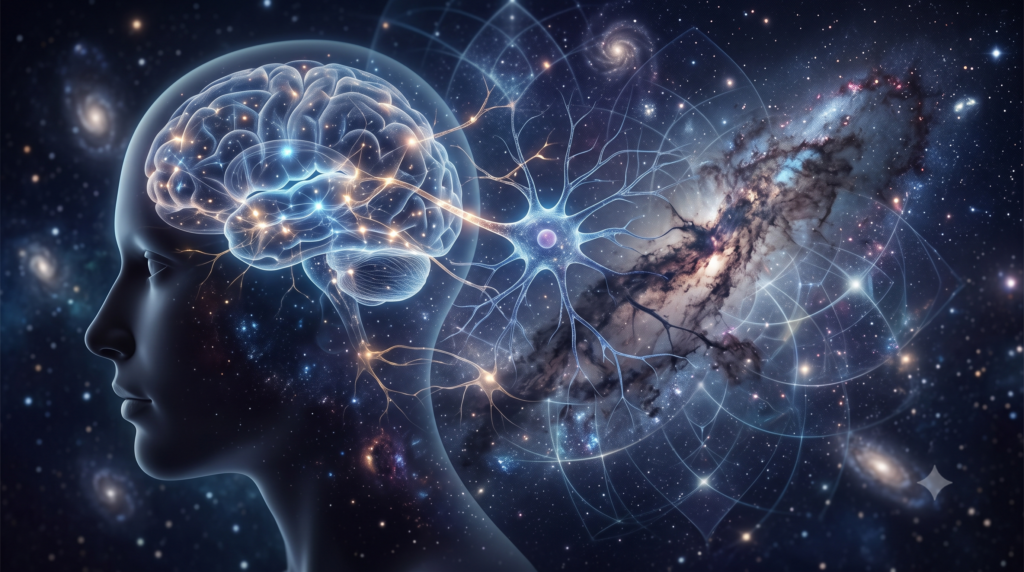
What If Consciousness Is a Fundamental Property of the Universe? Exploring Physics, Neuroscience, and Philosophy
What if consciousness is not something the brain creates from scratch, but a fundamental feature of reality? This idea appears in philosophy under names such as panpsychism and neutral monism, and it has recently gained renewed attention because neuroscience still struggles to explain why physical brain activity is accompanied by subjective experience.
There is no scientific consensus that consciousness is fundamental. Most neuroscientists study consciousness as something closely dependent on brain activity. Yet the philosophical problem remains: even if we map every neuron involved in seeing red, feeling pain or remembering a childhood event, why should those physical processes feel like anything from the inside?
This article explores the strongest versions of the idea without confusing speculation with established science.
What Does “Consciousness Is Fundamental” Mean?
In ordinary scientific thinking, fundamental properties are features that are not explained as combinations of something simpler. Space, time, mass, charge and quantum fields are treated as basic ingredients in physical theories.
To say consciousness is fundamental is to suggest that experience—or some primitive ingredient related to experience—belongs at a similarly basic level of reality.
This does not necessarily mean rocks think, planets have personalities or the universe has a human-like mind. Serious philosophical theories can be much more subtle.
The Hard Problem of Consciousness
Philosopher David Chalmers popularized the phrase “hard problem of consciousness” to distinguish two kinds of questions.
Science can investigate how the brain discriminates stimuli, controls behavior, stores memories and reports internal states. These are difficult but potentially explainable in functional terms.
The harder question is why any of those processes are accompanied by subjective experience at all. Why does seeing red have a particular quality? Why does pain hurt rather than occur as information processing with nobody “inside” experiencing it?
Theories that treat consciousness as fundamental are attempts to address this explanatory gap.
What Is Panpsychism?
Panpsychism is the view that consciousness, experience or proto-experiential properties are widespread and fundamental in nature.
Modern panpsychists generally do not claim that electrons have thoughts. Instead, they propose that the basic constituents of reality may possess extremely simple intrinsic properties that, when organized in the right way, contribute to complex consciousness.
The appeal of panpsychism is that it avoids trying to make experience emerge from something assumed to be completely non-experiential.
Its biggest difficulty is known as the combination problem: if tiny components have primitive experience, how do many such components combine into the unified consciousness of a person?
What Is Cosmopsychism?
Cosmopsychism reverses the direction. Instead of beginning with tiny conscious ingredients, it proposes that the universe as a whole may possess a fundamental form of consciousness or subjectivity, while individual minds somehow derive from it.
This is philosophically interesting but currently difficult to test. Without distinctive predictions, a metaphysical theory can remain compatible with scientific observations without being scientifically confirmed by them.
Neutral Monism: Mind and Matter From a Deeper Source
Another position is neutral monism. It proposes that mind and matter may both arise from something more fundamental that is neither exclusively mental nor exclusively physical.
Instead of asking whether matter produces consciousness or consciousness produces matter, neutral monism suggests both may be different aspects of a deeper underlying reality.
This kind of view has attracted philosophers because it tries to avoid the sharp divide between mind and matter without reducing one entirely to the other.
What Neuroscience Tells Us
Whatever the ultimate metaphysics of consciousness, neuroscience provides extremely strong evidence that ordinary human consciousness depends on the brain.
Brain injury can change personality, memory, perception and self-awareness. Anesthesia can suppress conscious experience. Sleep changes its structure. Electrical or chemical changes in neural systems can alter what a person sees, feels and remembers.
This means any theory of fundamental consciousness must still explain why our particular conscious experience tracks brain organization so closely.
Saying consciousness is fundamental does not remove the need for neuroscience.
Leading Scientific Theories of Consciousness
Researchers currently investigate several competing frameworks.
Global Workspace Theories
These propose that information becomes conscious when it is made broadly available across brain systems, allowing perception, memory, decision-making and action to interact.
Integrated Information Theory
Integrated Information Theory, or IIT, proposes that consciousness relates to the degree and structure of integrated causal information within a system. IIT is notable because some interpretations appear to assign consciousness more broadly than traditional neuroscience does.
However, IIT is an active and controversial research program, and its claims should not be treated as proof of panpsychism.
Higher-Order Theories
These theories propose that a mental state becomes conscious when the brain represents or is aware of itself as being in that state.
Recurrent Processing
Recurrent-processing theories emphasize feedback loops within sensory and cortical systems rather than a single one-way flow of information.
These frameworks show that consciousness research can make experimentally testable predictions without first deciding whether consciousness is metaphysically fundamental.
Does Physics Suggest Consciousness Is Fundamental?
Physics does not currently require consciousness as a fundamental variable in its successful equations. Quantum mechanics, relativity and particle physics can make extraordinary predictions without specifying subjective experience.
Nevertheless, physics has inspired philosophical questions because modern theories challenge common-sense pictures of reality. Quantum systems involve superposition, entanglement and measurement; relativity changes our understanding of space and time.
But strange physics is not automatically evidence for cosmic consciousness.
For a careful examination, read Does Quantum Physics Really Support Consciousness?
Does Quantum Mechanics Need a Conscious Observer?
A common claim says that quantum mechanics proves consciousness creates reality. That is not established.
In modern physics, “observation” usually refers to a physical interaction that records or correlates information. Detectors and environments can produce measurement-like effects without a person watching.
Some historical interpretations gave consciousness a special role, and quantum theories of mind such as Orch-OR continue to be debated. But none has demonstrated that human awareness is required for the physical universe to exist.
Could Information Be More Fundamental Than Matter?
Another route into the consciousness debate comes from information. Physics and computer science increasingly use information as a deep conceptual tool, and some theories of consciousness also emphasize information integration.
However, information by itself is not obviously experience. A hard drive contains information, but that does not show it feels anything. The central question remains: what turns physical or informational structure into subjective awareness?
The Brain as Producer vs Receiver
Some spiritual and philosophical traditions compare the brain to a receiver rather than a generator of consciousness—similar to a radio receiving a signal.
This analogy is intuitively appealing, but an analogy is not evidence. If consciousness existed independently of the brain, a scientific version of the theory would need to explain the mechanism, make distinctive predictions and survive experimental testing.
At present, changes to the brain provide much clearer evidence for changes in consciousness than any verified external “consciousness field.”
Why Near-Death Experiences Enter the Debate
Near-death experiences are often cited as evidence that consciousness can exist independently of the brain. People report vivid perceptions, a sense of leaving the body, encounters with beings or panoramic memories.
These experiences deserve respectful scientific study, but they do not currently prove consciousness survives brain death. Researchers investigate neurological, psychological and physiological explanations, including changes in oxygen, neurotransmission, memory and brain-network activity.
The question remains emotionally and philosophically important, but extraordinary interpretations require extraordinary evidence.
Ancient Philosophy and Universal Consciousness
Indian philosophical traditions have long explored ideas in which individual consciousness is connected to a deeper reality. Advaita Vedanta, for example, questions the ultimate separation between individual self and Brahman.
These traditions are philosophically sophisticated, but they should not be retroactively labeled modern physics. Spiritual insight and scientific explanation operate with different methods and standards of evidence.
Related themes appear in our article The Primal Energy of the Universe: Two Scientific Perspectives 3,500 Years Apart.
Could AI Ever Be Conscious?
The rise of advanced AI makes this philosophical debate more urgent. If consciousness depends only on certain kinds of information processing, sufficiently advanced artificial systems might in principle become conscious.
If consciousness instead depends on specific biological processes, ordinary digital AI may never have genuine experience regardless of how intelligently it behaves.
And if consciousness is fundamental, the question becomes even stranger: what kinds of physical organization allow fundamental experiential properties to form a unified subject?
AI therefore turns an old philosophical puzzle into a practical ethical problem. We may eventually need criteria for deciding whether an artificial system merely simulates awareness or actually experiences something.
What Evidence Would Change the Debate?
A strong scientific theory of fundamental consciousness would need more than philosophical elegance. Ideally, it would:
- define consciousness or its basic properties precisely;
- connect those properties to measurable physical variables;
- make predictions different from competing theories;
- explain why brain states correlate with human experience;
- survive attempts at experimental falsification.
Without testable consequences, the idea remains primarily metaphysical rather than empirical.
Why the Fundamental-Consciousness Idea Persists
It persists because neither strict materialism nor dualism has produced an explanation that everyone finds satisfying.
Materialist theories are powerful at explaining correlations and functions, but critics argue that subjective experience remains unexplained. Dualist theories preserve the uniqueness of mind but face difficulty explaining how a nonphysical mind interacts with physical matter.
Panpsychism and related approaches attempt a third route.
A Balanced Scientific Position
The strongest position today is one of disciplined openness.
We know that consciousness is intimately related to brain activity. We do not yet have a universally accepted theory explaining why certain physical processes produce subjective experience. Philosophy therefore remains relevant—but philosophical possibility should not be mistaken for experimental confirmation.
Final Verdict
Could consciousness be a fundamental property of the universe? Yes, it is a serious philosophical possibility. Is it scientifically established? No.
Neuroscience strongly links human consciousness to the brain, while physics currently does not require consciousness as a fundamental ingredient. Panpsychism, cosmopsychism and neutral monism remain important attempts to explain the hard problem, but none has decisively solved it.
The most interesting lesson may be that consciousness is not a small mystery sitting inside neuroscience. It is a question that touches physics, biology, philosophy, artificial intelligence and our deepest assumptions about what reality is.
Frequently Asked Questions
Is consciousness a fundamental property of the universe?
It is a philosophical possibility proposed by panpsychism and related views, but it has not been established by experimental science.
What is panpsychism?
Panpsychism is the view that consciousness or primitive experiential properties are fundamental and widespread features of reality.
Does neuroscience prove the brain creates consciousness?
Neuroscience shows extremely strong dependence between brain states and conscious experience, but the deeper philosophical question of why brain processes are accompanied by subjective experience remains unresolved.
Does quantum physics prove universal consciousness?
No. Quantum mechanics contains nonclassical phenomena, but it does not currently demonstrate that the universe is conscious.
Could AI become conscious?
Possibly, depending on what consciousness ultimately requires. There is currently no accepted scientific test that can determine whether a sophisticated AI has subjective experience.