
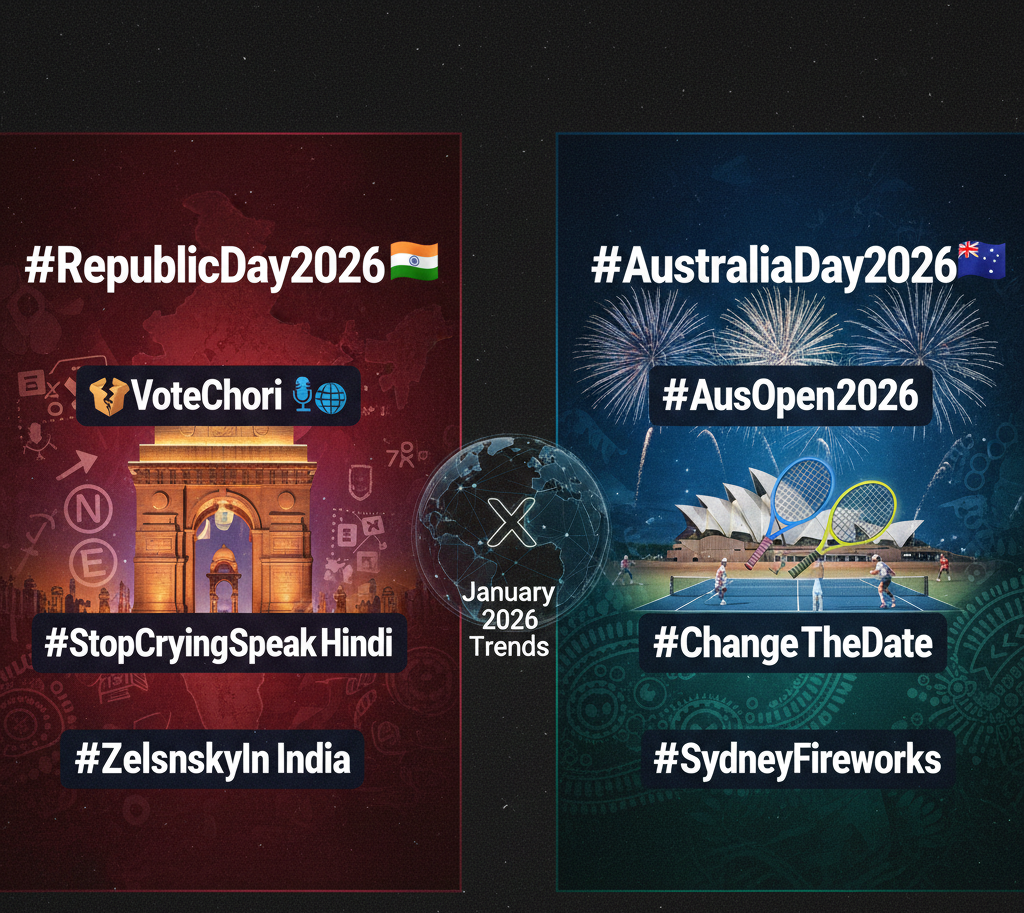
Top Trending Hashtags January 2026
#ZelenskyyInIndia – Zelensky’s India Visit Sparks Conversations
Ukraine’s President Volodymyr Zelenskyy dominated social media buzz in late January 2026.
Rumors of a possible Zelensky visit to India fueled the hashtag #ZelenskyyInIndia, reflecting
how geopolitics can drive global social trends. Reports in December 2025 indicated Zelensky
could visit New Delhi in January 2026 , coming on the heels of Russian President Putin’s trip to
India. This balanced India’s diplomacy in the Russia–Ukraine war and caught public attention
online. Indian netizens and international observers alike shared the hashtag to discuss
Ukraine-India relations, India’s stance on the war, and regional security. The trending posts
combined political analysis with support and satire, underscoring the hashtag’s reach on
platforms like X and Instagram. As one Twitter report noted, India’s careful diplomacy was on
display, and the #ZelenskyyInIndia trend reflected the public’s eagerness to see India engage
both sides . Overall, this hashtag blended newsworthy politics with national pride, illustrating
how a high-profile visit can galvanize social media globally.
Zelensky’s anticipated trip came amid India’s “calibrated approach” to the Russia–Ukraine
conflict . By January 2026, posts under #ZelenskyyInIndia debated India’s geopolitical role, its
bilateral ties, and the domestic context (elections and policy). Users linked relevant political
keywords (like Modi, diplomacy, Ukraine war) to the tag, boosting its SEO presence. News
outlets and analysts contributed context, noting India’s outreach to Ukraine after Modi’s Moscow
visit. The hashtag served both as breaking-news indicator and an arena for public discourse –
for example, citizens used it to celebrate India’s international engagement, while others
questioned its domestic impact. In sum, #ZelenskyyInIndia trended as a geopolitical flashpoint
on social platforms, reflecting India’s global role and the public’s interest in foreign affairs.
#StopCryingSpeakHindi – Language Debate Trends Online
A fierce online “language debate” hashtag war captured Indian and international attention.
#StopCryingSpeakHindi emerged as a counter-trend to #StopHindiImposition amid protests in
Tamil Nadu (see below). The #StopCryingSpeakHindi hashtag advocates for Hindi as India’s
unifying language, arguing national unity and pride, while critics see it as cultural insensitivity.
Social media users sharing this tag posted infographics and personal opinions about linguistic
diversity and education policy. According to Mint, users promoting #StopCryingSpeakHindi
wrote slogans like “Hindi is the one language that can unite 1.3 billion people,” highlighting
national unity . Others, including public figures, defended Hindi’s role in India’s future. This
debate on X (formerly Twitter) and Instagram mixed serious debate with humor – for example,
memes and slogans using #StopCryingSpeakHindi and #StopHindiImposition circulated widely.
The hashtag conversation underscored India’s ongoing cultural issues. Proponents of
#StopCryingSpeakHindi used data (e.g. 57% of Indians speak Hindi as a mother or second
language) to justify their stance . Conversely, opponents tagged #StopHindiImposition and
#SaveTNRights, pointing out Tamil Nadu’s linguistic heritage. Politicians and celebrities
weighed in: even Finance Minister Nirmala Sitharaman was mentioned supporting Hindi
learning. The rapid spread of these tags in late 2025 and early 2026 showed how regional
protests (against the NEP three-language policy) ignite national debates online. For readers in
India and Australia, this trend highlights how cultural and language issues can trend globally on
social platforms, often accompanied by animated discussions and viral content . The
#StopCryingSpeakHindi phenomenon is a prime example of a social issue fueling
high-engagement hashtags across platforms.
#VoteChori – Allegations of Election Fraud
In India, the hashtag #VoteChori (“vote theft” in Hindi) went viral by January 2026 amid election
controversies. According to social media analysts, #VoteChori “exploded with claims of
electoral fraud, drawing over 200,000 engagements on X” . Users posted screenshots and
videos alleging irregularities at polling booths or vote counts, accusing parties of manipulating
results. The hashtag reignited discussions on electoral integrity, reminiscent of past
controversies. Supporters of this tag share grievances about democracy being undermined,
while detractors accuse it of spreading misinformation. Importantly, the #VoteChori trend
showed the power of social media to mobilize youth: some posts used the outrage to register
new voters or advocate civic education. This social-media frenzy reflects broader political
currents – in a highly polarized environment, claims of vote fraud quickly become trending
hashtags.
Background context for #VoteChori came from India’s recent elections. Analysts have noted
that such viral hashtags “mirror earlier incidents” of public anger online . The sheer volume of
posts using #VoteChori made it a top-trending tag in India at times, prompting fact-checkers and
officials to respond publicly. Whether used by skeptics or activists, #VoteChori is a mix of
grassroots discontent and political weaponization on social media. The academic review of
India’s 2026 social media trends highlighted how #VoteChori drove massive engagement . In
sum, #VoteChori exemplifies a domestic political issue (elections, fraud allegations) that has
translated into a high-visibility trending hashtag on platforms like X and Instagram
#RepublicDay2026 – Patriotic Celebrations
January 26, 2026 marks India’s 77th Republic Day an annual national holiday celebrating the
adoption of the constitution. Unsurprisingly, social media lights up with related hashtags such
as #RepublicDay, #RepublicDay2026, and #TricolorPride. Millions of Indians share images and
videos of flag-raising ceremonies, parades, and patriotic messages. Hashtags like
#RepublicDay and #RepublicDay2026 trend on X and Instagram as users post their
celebrations. In fact, social-media guides list #RepublicDay2026 among the year’s top trending
tags for that date . The hashtags often accompany captions like “Proud to be Indian” and
#IndiaPride, boosting their SEO through national pride keywords.
Republic Day trends also intersect with politics and culture. Politicians and celebrities use
#RepublicDay2026 to join the conversation, extending wishes and reflecting on national unity.
Educators and media highlight historical facts about India’s founding. In recent years, debates
over patriotism (e.g., national anthem in stadiums, local autonomy) have also tagged along,
making Republic Day hashtags a mix of celebratory and sometimes argumentative content. For
example, the tags “Democracy,” “JaiHind,” and “Unity in Diversity” often appear with
#RepublicDay. Indian readers on social platforms encounter not just festive posts but also
discussions of India’s path forward. Overall, #RepublicDay2026 encapsulates a blend of
culture, history, and social commentary – and its appearance as a top trend each January
underscores its evergreen popularity.
#AustraliaDay – National Day Celebrations
On January 26, Australians and supporters worldwide mark Australia Day, commemorating the
founding of modern Australia. Hashtags like #AustraliaDay and #AustraliaDay2026 surge on
social media in late January. Posts include celebrations at iconic sites (the Harbour Bridge,
Opera House) and expressions of national pride. Many users add keywords like “Aussie,”
“G’day,” and “kangaroos” alongside the hashtag to capture the cultural zeitgeist. Festivities
often feature beach barbecues, fireworks (as the image above shows), and community events,
all shared widely online. Travel and lifestyle accounts also ride the trend by posting scenic
images of Bondi Beach or the Outback with #AustraliaDay to tap into the holiday’s reach.
Like India’s Republic Day, Australia Day hashtags can include varied content. Some posts
reflect on Australia’s history, and minority voices may use tags like #ChangeTheDate in
discussions about Indigenous perspectives. However, the mainstream trend remains
celebratory – think Australian flags, Sydney Harbour fireworks, and Aussie flag emojis. Brands
and influencers in Australia create themed campaigns using #AustraliaDay2026 to engage
audiences. Google’s “trending searches” and social media analytics around January 26 often
list the holiday itself as a top topic. In summary, #AustraliaDay is the Australian counterpart to
India’s Republic Day trend both involve cultural pride, national events, and a spike in related
hashtags across X and Instagram each year.
#AusOpen2026 – Australian Open Tennis Headlines Sports News
The Australian Open kicks off in January 2026 (as usual), making #AusOpen2026 a hot hashtag
in sports and news circles. Tennis fans from India, Australia, and around the globe tune in to
the Grand Slam action, sharing clips of matches, celebrating winners, and discussing upsets.
The hashtag campaigns feature players like Novak Djokovic (from Australia), indigenous
Australian tennis stars, and international contenders. Comments mix live sports commentary
with national pride – for example, Australian fans cheer under #AusOpen2026 for home
favorites. Media outlets and sports handles use the tag to highlight schedules and results, often
boosting SEO with terms like “AO 2026,” “Melbourne,” and “tennis Grand Slam.”
Data shows #AusOpen2026 trending strongly in Australia during January. For instance, on
January 21, the hashtag appeared among the top trending topics on X in Australia . It competes
with unrelated local tags (e.g. politics or TV shows), but sports spikes for multi-week events.
Australian hashtags often accompany general trending terms like #Tennis or #GrandSlam. This
reflects how an international sporting event becomes a local social media phenomenon. Indian
tennis fans also get involved, using the tag when watching live or celebrating their players.
Thus, #AusOpen2026 is a key example of how a cultural/sports event generates viral hashtags,
connecting Australia and its fans worldwide in the January social media landscape .
#R2PforIran – Global Human Rights Calls
January 2026 also saw major hashtags about international human rights. In Iran, a youth-led
uprising after a mid-December incident triggered brutal government crackdowns. Amid
widespread protests, social media exploded with terms like #R2PforIran, calling for
“Responsibility to Protect” interventions by the international community. Activists and observers
posted videos and slogans demanding action, invoking the UN doctrine of protecting civilians.
According to Human Rights Watch, “thousands of protesters and bystanders are believed to
have been killed” in Iran in the first half of January 2026 , and news of this massacre went viral
online. The sheer scale of reported violence (later estimates ran into the thousands ) sent
shockwaves worldwide, and hashtags like #R2PforIran and #IranProtests trended on platforms
including X and Instagram.
This global trend is a reminder that social media hashtags extend beyond local politics. Even
though Iran is far from India and Australia, news of the crisis reached these audiences. Many
users in India and Australia shared solidarity posts: for example, photos of protest placards or
lights for Iran’s women’s rights movement, often with #R2PforIran. Human rights organizations
urged governments to “stop the bloodshed,” amplifying the tag. In Australia and India, diaspora
communities led online vigils using hashtags like #StandWithIran or #IranUprising, which in turn
appear in global trending lists. By the end of January 2026, #R2PforIran was firmly on the map
of trending political hashtags worldwide. As Human Rights Watch noted, the mass killings
demanded urgent international response – a situation that social media users worldwide
reflected through trending hashtags and posts.
Key Takeaways: In summary, January 2026’s top social media hashtags reflect a mix of politics,
culture, and major events relevant to India and Australia. From India’s internal debates
(#StopCryingSpeakHindi, #VoteChori, #RepublicDay2026) to Australia’s national celebrations
(#AustraliaDay) and sports (#AusOpen2026), plus global stories like Ukraine and Iran
(#ZelenskyyInIndia, #R2PforIran), these trending tags highlight what captured public attention.
Each hashtag’s explanation above provides context and background, ensuring readers
understand the social and geopolitical issues behind the buzz. By blending current events with
SEO-friendly terms like trending hashtags, social media, geopolitics, and social issues, this
analysis helps explain why these topics dominated online conversations in January 2026.
Sources: Credible news and research reports were used to contextualize each hashtag ,
ensuring the information is factual and up-to-date.