
Greenland’s Allure: Why the U.S. Eyes the Arctic Giant
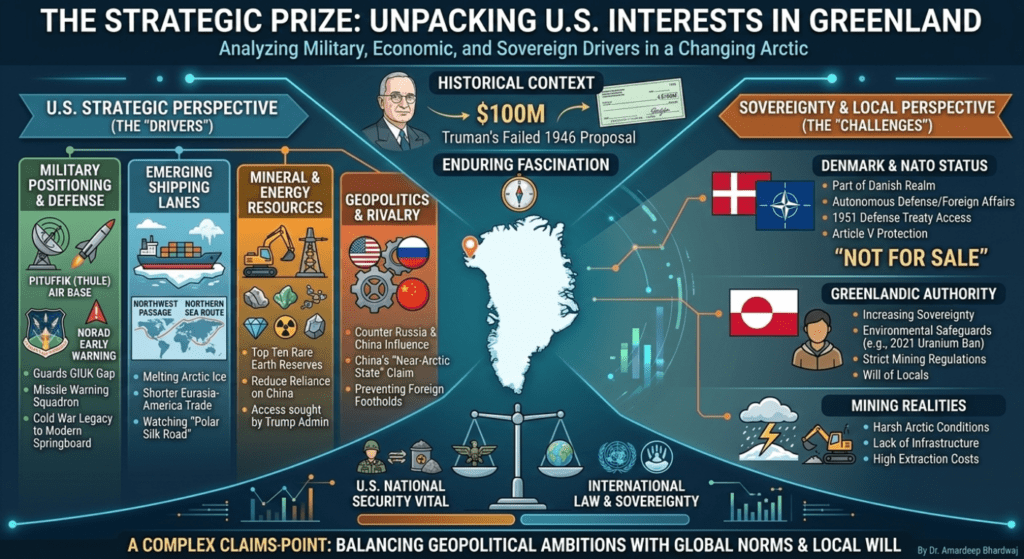
Greenland has long fascinated U.S. policymakers – not just as a quaint island, but as a strategic prize. In the waning days of World War II, President Harry Truman famously offered Denmark US$100 million for Greenland (a proposal Denmark forcefully and spontaneously rejected). The episode foreshadowed enduring U.S. interest. Today, Arctic melting ice, climate change, and most importantly, big-power rivalry have added new dimensions to this island, making it a potential clash-point. In fact, modern U.S. leaders brazenly argue that Greenland’s location is “vital to U.S. national security, throwing aside all norms of legality, sovereignty, decency and mutual respect. In fact, many of their arguments are concocted and made up of half-truths, if not lies. Below, we explore the main drivers of U.S. interest in Greenland, from historical to contemporary factors:
- Strategic Military Positioning. Greenland guards the Arctic approaches to the North American sub-continent (the Greenland–Iceland–UK, or GIUK, gap). It already hosts U.S. military bases.
- Emerging Arctic Shipping Lanes. Warming seas could possibly open up new routes (Northern Sea Route and Northwest Passage) that would pass near Greenland, shortening Eurasia-America trade.
- Mineral and Energy Resources. Beneath its ice and rock lie vast deposits of rare earths, uranium, zinc and possibly oil – minerals crucial for tech and energy transitions. So, its more of greed for these minerals that prompts the USA to disguise them as national security threats.
- Geopolitics and Rivalry. U.S. strategists worry that without vigilance, Russia or China could exploit Greenland. China in particular has proclaimed a “Polar Silk Road” in the Arctic, spurring U.S. caution. But, these arguments are, at best, hollow and there is no real threat of this nature.
- Alliance and Sovereignty Issues. Greenland is part of the Danish realm and NATO’s northern flank. Denmark and Greenlandic authorities have repeatedly insisted the island “is not for sale,” even as they are arm-twisted into negotiations on security cooperation by the big bully, USA.
Each factor is a piece of the puzzle. The sections below unpack these motivations, balancing Greenland’s history with today’s challenges.
Arctic Geopolitics & Military Positioning
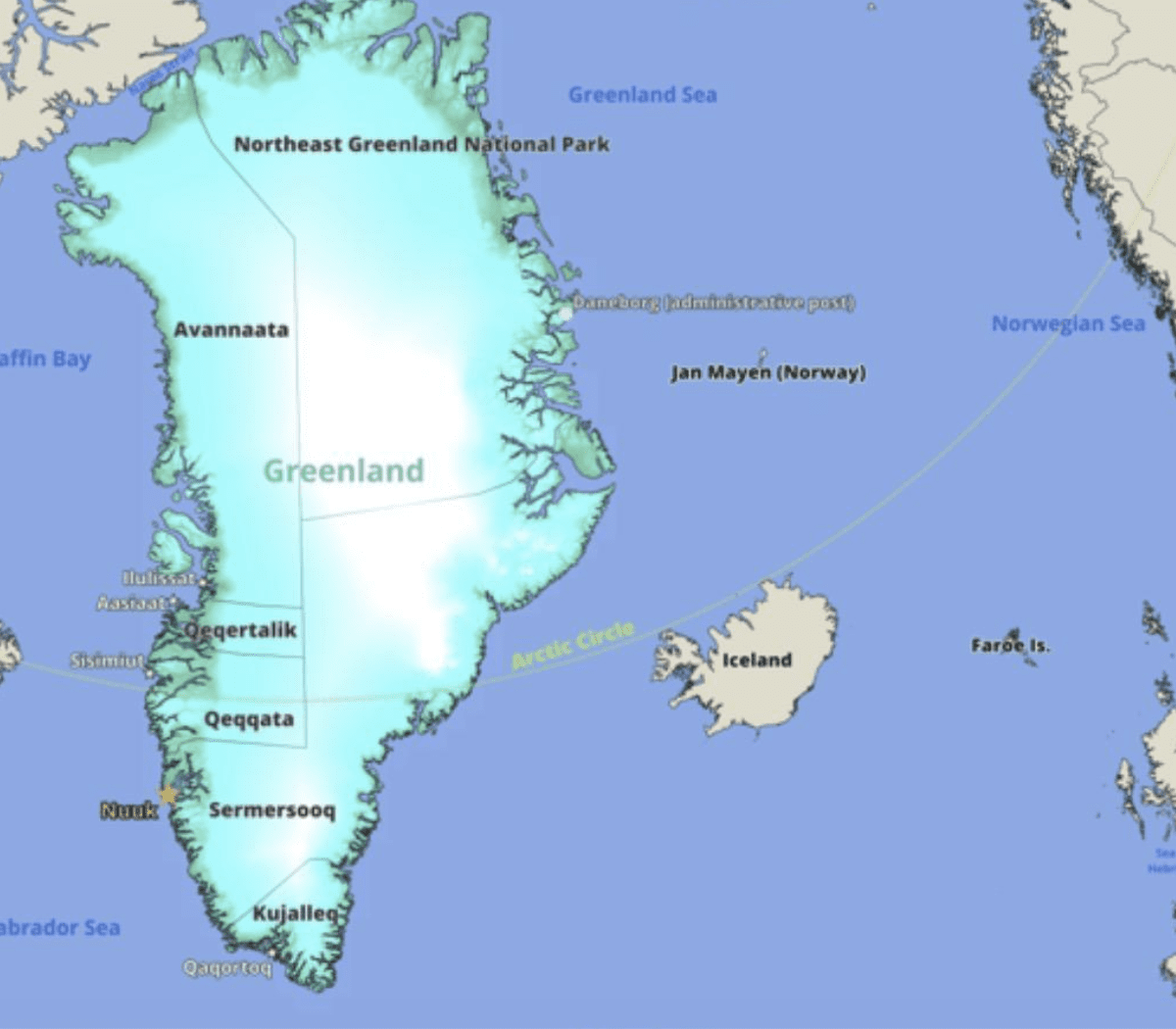
Greenland’s position atop the globe gives it extraordinary strategic value. A CNN analysis notes that Greenland’s landmass lies closer to New York City than Los Angeles. With about 44,000 kilometers of coastline (longer than Earth’s equator), Greenland oversees the Arctic and Atlantic approaches. This makes it a natural bastion for tracking air and sea traffic. During the Cold War, U.S. and Canadian forces integrated Greenland into the North American Defense (NORAD) radar network, and even planned underground missile sites there. Today, the U.S. still operates a key base at Pituffik (Thule) Air Base: its polar radars (the 12th Space Warning Squadron of the Space Force) constantly sweep for incoming missiles or satellites over the pole.
As one analyst bluntly put it, Greenland had become a “security black hole” – it’s hard to monitor such a vast, dark region without more assets.
Modern exercises underscore Greenland’s military role. The U.S. routinely sends fighters and ships north in joint drills with Denmark and NATO allies. Pituffik’s “ground-based radar provides early missile warning to track potential inbound missiles launched at the U.S. homeland” (for example from Russia). It is literally the northernmost U.S. military installation on Earth, linking into broader polar defense. In sum, Greenland is a strategic springboard – controlling Arctic airspace and sea lanes – which is why the U.S. has kept a continuous military presence there since World War II.
Climate Change and New Shipping Lanes
As the Arctic warms, Greenland’s role in global shipping and trade is evolving. Satellite data shows that fewer than 2% of the world ships venture into Arctic waters today, but that fraction is rising: between 2013 and 2023 the number of ships entering the Arctic climbed by 37% . Melting ice could open the Northern Sea Route (along Russia’s coast) and Northwest Passage (through the Canadian Arctic) for longer seasons. Those routes dramatically shorten Europe-Asia voyages. For instance, a Chinese state media report highlights a 2023 container voyage via the Northern Sea Route that cut Asia-Europe transit from 40 days to just 20.
However, experts caution that the Arctic’s future shipping boom may be overhyped. The waters are still treacherous – loose ice floes, few ports, and brutal weather. Even during last summer’s ice minimum, only ~1,800 ships went north (mainly fishing or research vessels). Still, Greenland sits astride any future trans-Arctic corridor, giving whoever controls it a say in new freight flows. The Chinese idea of a “Polar Silk Road” has grabbed headlines, and the U.S. is watching carefully: ensuring open navigation and friendly oversight of these emerging lanes is part of America’s interest.
Mineral and Rare Earth Resources
Beneath Greenland’s ice and rocks lie huge mineral deposits that could spark a 21st-century gold-like rush. Geological surveys rank Greenland’s rare-earth reserves among the top ten in the world. Twenty-five of the 60 critical minerals identified by the U.S. (including rare earths, Uranium, Zinc, Copper, etc) are present in Greenland. Notable sites include the Kvanefjeld/Tanbreez fields, rich in rare earths and Uranium. During 2026 negotiations, the Trump administration reportedly sought to guarantee U.S. mining access to these assets while barring non-NATO competitors. The US logic is clear: reduce reliance on China for rare earths (now holding a virtual monopoly) by tapping Greenland’s wealth.
Yet mining Greenland is no simple task. Companies warn that extreme conditions and lack of infrastructure make extraction costly. As mining executive Michael Jardine put it, Greenland’s “harsh realities” – ice, distance, unpredictable weather – have scuttled projects despite rich ore in sight. Moreover, Greenlandic and Danish governments impose strict environmental safeguards. For example, Greenland’s ban on Uranium mining (approved in 2021) effectively halted development of Kvanefjeld, despite a 6.5% Chinese investment stake in it . In short, while Greenland’s minerals are enticing, exploiting them requires massive roads, ports and power – and careful diplomacy with an increasingly sovereignty-minded Greenlandic government.
China’s Influence and Arctic Competition
China’s Arctic ambitions add urgency to U.S. interest in Greenland. Beijing has declared itself a “near-Arctic state” and openly promotes a “Polar Silk Road” through polar shipping routes. Over the past decade China poured significant investment into Greenland (airports, mining exploration, even an abandoned naval site): between 2012–2017 Chinese investment equalled over 11% of Greenland’s GDP. Western analysts worry that any foothold could allow China leverage over Arctic resources or shipping.
So far, Denmark and other allies have pushed back. In 2018 Denmark (reportedly under U.S. arm-twisting) blocked a Chinese bid to expand Greenland’s airport network, and an earlier attempt to buy a Greenland base. Chinese companies also struggled with Greenland’s 2021 Uranium mining ban, which stalled that rare-earth project. Nevertheless, Beijing continues to woo Arctic nations with research and infrastructure projects, so the U.S. sees Greenland not just as real estate, but as a front in the larger big-power competition. As one expert noted, the possibility of a weakened U.S. alliance or Greenlandic independence could tempt Greenland toward Russia’s or China’s orbit – a development Washington wants to avert.
NATO, Denmark, and Greenland’s Status
Any U.S. moves in Greenland must navigate politics within NATO and the Danish realm. Greenland is an autonomous part of the Kingdom of Denmark, and Copenhagen retains control over its defense and foreign affairs. Both Denmark and Greenland’s leaders have firmly declared Greenland is “not for sale”. Rather than outright acquisition, Denmark has suggested expanding U.S. military presence by agreement – for instance by strengthening bases and surveillance.
In recent talks at NATO, Danish officials have urged that Arctic security become a collective priority. Denmark’s prime minister and NATO’s Secretary-General publicly agreed to boost Arctic defense cooperation. Think tanks are even proposing an “Arctic Sentry” NATO mission: enhanced joint airfields, missile defense radars, and patrols covering Greenland and the GIUK gap . All this builds on the 1951 Greenland Defense Treaty (a NATO-era pact) which already grants the U.S. broad military access while preserving Danish sovereignty.
In practice, the U.S. already enjoys a significant footprint under these frameworks. Today only a few hundred personnel are in Greenland, but they handle critical tasks like NORAD early warning and satellite control. NATO allies regularly send ships and aircraft to train in Greenlandic waters. If Greenland’s security were ever threatened, Article V would oblige allied support as it would for Denmark. In short, Greenland’s fate remains tied to NATO. Any change (whether a greater U.S. role or Greenlandic independence) would require careful diplomacy so as not to fracture the alliance or Danish-Greenlandic relations.
Conclusion
From Truman’s 1946 proposal to Trump’s 21st-century tweets, Greenland has captured U.S. attention more than any other icy expanse. Its historic role as a Cold War stronghold and current function as a missile-warning outpost underline the “big picture” motive: continental defense. Now, climate change is opening a new chapter – drawing great-power rivalry to the high north via shipping routes and resource rushes. The United States’ mix of military, economic, and diplomatic engagement in Greenland reflects this. In each category Arctic strategy, trade routes, minerals, countering China, and alliance commitments – Greenland’s stakes are high. As one analyst put it, Greenland “is in a very strategic place in the Arctic for many different interests”. Whether the future holds closer U.S.-Greenland cooperation or Greenlandic independence, American policymakers clearly see Greenland as far more than “just another icy island.” But that is only the US part of the story. To be fair, all the other parts also need to be studied to gain a balanced perspective of the current controversy. And what is more, the globally accepted norms of international law, UN mandates, sovereignty issues and will of the locals also need to be given their due cognizance, without getting over-awed by illegitimate and greedy selfish interests of the big bully, USA.