
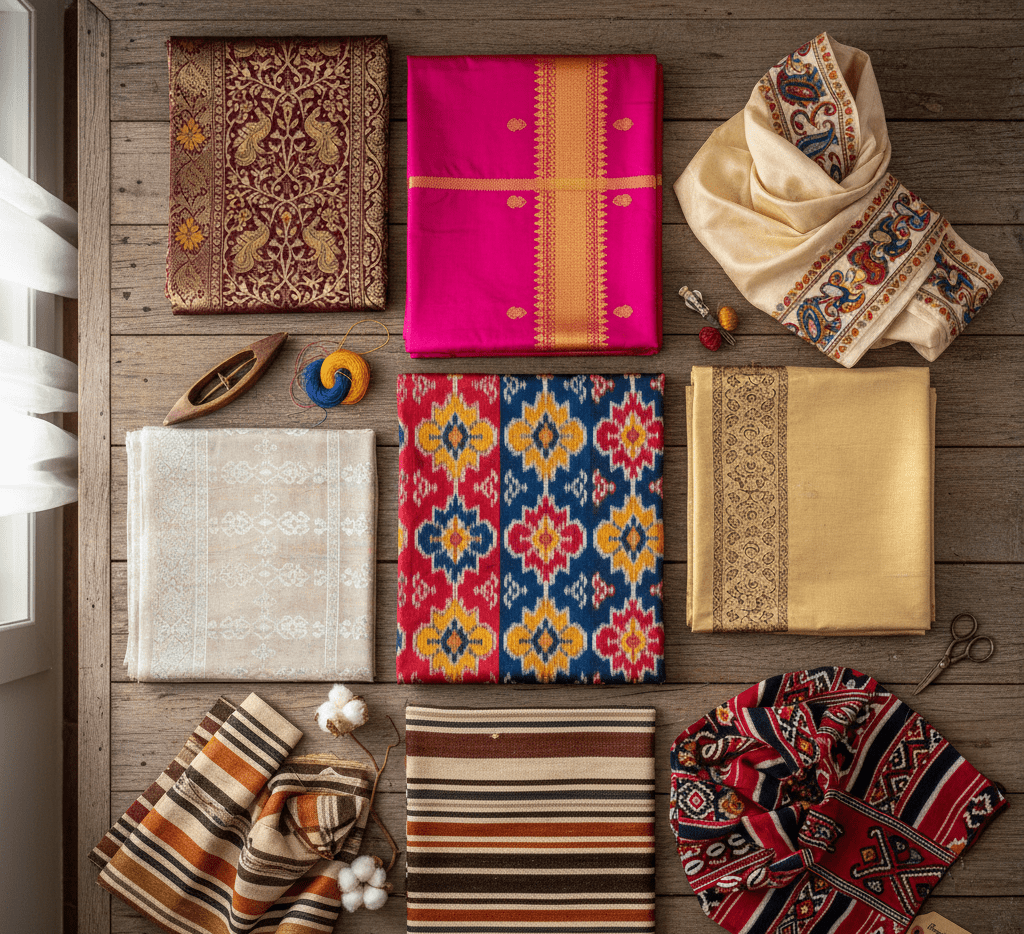
The Finest Weaves of Indigenous India
India’s handloom tradition is a vibrant tapestry of regional art and history. From the brocaded
Banarasi silks of Varanasi to the double-ikat Patolas of Gujarat, each weave tells a story of
cultural identity. Traditional looms still clatter in villages from Tamil Nadu’s Kanchipuram to
Assam’s Sualkuchi, preserving ancestral skills. In Banaras, for example, a master weaver at a
handloom may spend up to two months crafting a single silk sari . Such painstaking artistry
underpins livelihoods: roughly 3.52 million Indians work in the handloom sector, over 70% of
them women . Across rural India, weaving is both income and inheritance a living heritage as
diverse as the country itself.
Iconic Weaves Across India
● Banarasi (Varanasi, UP): Famous for its gold-and-silver brocade, Banarasi silk weaves
have royal roots. Banaras still thrives on this craft about 25% of the city’s population
(≈110,000 people) are weavers . Mughal and Hindu motifs intertwine in these saris,
reflecting centuries of cultural exchange .
● Kanjeevaram (Kanchipuram, TN): South India’s jewel, this pure mulberry silk is woven in
Kanchipuram. Legends trace its origins to the 7th-century Pallavas, and to Sage
Markanda gifted in weaving . Kanjeevaram saris are prized for their durability,
temple-inspired borders, and vibrant colors often passed down as bridal heirlooms .
● Chanderi (Madhya Pradesh): A lightweight cotton-silk weave from Chanderi has
flourished for over 600 years . This historic town was on medieval trade routes, and even
today nearly half its population depends on weaving . Chanderi motifs often draw from
local architecture and Mughal art, giving its translucent silk a timeless elegance.
● Patola (Gujarat): The double-ikat Patola of Patan is a richly colored silk, woven by the
Salvi community. Both warp and weft threads are meticulously resist-dyed, creating
geometric and floral patterns. Historically reserved for nobility, Patolas have “queen of
silks” status for their complexity. (They may be mentioned as six-shaala and are
extremely labor-intensive.)
● Ikat Variants (Odisha, Andhra, Gujarat): Regions like Odisha, Andhra Pradesh, and
Gujarat have their own ikat traditions. Odisha’s Bandhakala or Sambalpuri ikat (including
the famous Khandua sari of Nuapatna) uses tie-dye resist on yarns. Legends link
Khandua (Maniabandha) to Lord Jagannath and poet Jayadeva over 800 years ago .
The double-ikat Patola is Gujarat’s ikat star. Even Andhra’s Pochampally ikat (Telia
rumal technique) adds to this pan-India tapestry.
● Bhujodi (Kutch, Gujarat): In the village of Bhujodi near Bhuj, the Vankar community
weaves simple cotton and wool shawls, stoles and blankets. Bhujodi designs feature
bold geometric patterns in rich natural-dye colors . This centuries-old tradition is vital to
Kutch’s identity and economy . Local families depend on it, and recent efforts are
reviving interest by blending Bhujodi textiles into contemporary fashion .
● Pashmina (Kashmir): Kashmir’s Pashmina shawls are woven from the downy undercoat
of Changthangi goats. Fabled for their supreme softness and warmth, Pashminas were
patronized by Mughals and Rajahs. Skilled Kashmiri weavers spin very fine yarn,
sometimes incorporating intricate Sozni embroidery or “kani” tapestry motifs, making
each shawl a wearable work of art.
● Muga and Assam Silks: Assam’s ancient silk tradition centers on two wild silks. Muga
silk, a natural golden fiber, is unique to Assam. Weavers here draw on a heritage going
back to the 4th century BC (even mentioned in the Arthashastra), and long call
themselves custodians of “the finest of India’s wild silks” . Nearby, Eri (warm winter silk)
and mulberry silk looms also thrive, often in rural homes. Weaving is literally a way of life
in Assam, and every household loom carries on these “centuries-old traditions of motifs,
colours and design” .
● Tribal Weaves (Odisha & Northeast India): Tribal communities across eastern India keep
vibrant handloom arts alive. In Odisha’s tribal belt, Bandha (ikat) saris and fabrics like
the Sambalpuri, Bomkai, and Bhanjpur designs bear symbolic motifs (flowers, animals,
mythic patterns). The Dongria Kondh make the Kapagandha shawl and the Bondas the
Ringa cloth, each reflecting tribal lore . In the Northeast, Nagaland’s Naga shawls are
perhaps the most emblematic. Each shawl’s pattern and color denotes the wearer’s
tribe, rank and achievements. These handwoven textiles literally communicate status
and stories a “proud assertion of identity” among Naga communities .
Weaving as Livelihood and Culture
In these regions, weaving is not just art; it’s an economic backbone. UNESCO notes that entire
towns grew around loom clusters, and even the architecture weavers’ houses with attached
workspaces evolved to meet artisans’ needs . In Banaras and Mubarakpur (UP), the majority of
households are directly engaged in weaving . In fact, “ninety percent of [Mubarakpur’s] working
population is engaged in weaving” and about 20,000 weaver families live there . Nationally,
handloom employment helps millions of rural families. According to India’s Fourth Handloom
Census (2019-20), over 3.52 million people work in handloom weaving, and women make up
about 72% of that workforce . Many of these are small, low-income households: roughly 67% of
handloom households earn less than ₹5,000 monthly, making weaving their crucial income or
buffer against agricultural uncertainty .
Handloom textiles also matter globally. India’s textile exports are booming: in FY24 the country
shipped US$ 35.9 billion worth of textile products, and projections aim for $100 billion by 2030 .
Textiles (including handicrafts) contribute about 12% of India’s export earnings and 13% of
industrial output . Handloom pieces with their natural fibres and eco-friendly dyes fit the rising
demand for sustainable, artisanal products. In sum, weaving preserves cultural identity while
providing livelihoods for millions.
From Golden Ages to Modern Challenges
Historically, many of India’s weaves were court-endorsed: Mughals, Nawabs and Maharajas
were patrons of Banarasi, Paithani and Pashmina. British colonialism and industrialization (from
the 18th century) introduced mechanized mills, and later powerlooms. This shift dented
handloom’s dominance. In Karnataka, for example, a once-thriving state-run silk weaving
corporation (KHDC) fell from 40,000 weavers to under 4,000 in a decade . Nationwide,
handloom census figures have steadily declined.
The rise of powerlooms has been especially disruptive. Power-loomed fabrics flood the market
at low prices, making it hard for handloom weavers to compete. As one report lamented,
powerlooms “snatched away jobs” and drove prices down, so that “cheaper powerloom
sarees… made it impossible for the handloom weavers to survive” . Younger artisans often
leave villages for powerloom mills or factory jobs where pay is comparable and work less
arduous . Slow handweaving sits uneasily against fast fashion: with quick copy-cat designs and
no regard for craft, traditional weavers struggle for market share.
Despite these challenges, revival efforts are underway. The government has launched schemes
like mega handloom clusters and ‘Handloom Day’ promotions. Products of GI (Geographical
Indication) status e.g. Chakhesang Naga shawl help safeguard authenticity . Designers and
social enterprises are innovating: Bengaluru label Boito, for instance, works with Odisha’s
handloom villages to revitalize weaves like Khandua and tribal kapad, blending heritage
patterns into contemporary apparel . The goal is to give artisans new markets (export and
online) and better incomes, while keeping handlooms economically viable. After all, over
one-fifth of India’s cloth is still made on handlooms , a testament to the craft’s resilience.
Conclusion
From the glittering gold threads of a Paithani to the earthy cotton of an Assamese Mekhela,
India’s indigenous weaves express deep regional identities and artistry. Each motif, fibre and
dye connects to history Mughal courts, temple rituals, tribal folklore yet these textiles remain part
of everyday life. They sustain families and communities even today. Preserving these traditions
amid modern pressures is crucial. As the pieces above illustrate, there is global admiration and
growing demand for handloom crafts, and a wealth of knowledge within Indian villages. By
championing handloom weaves through conscious consumer choices, supportive policies and
creative design we ensure that India’s finest weaves continue to tell their story for generations to
come.
Sources: Historical and cultural details on Banarasi, Chanderi, Kanjeevaram, Patola, Bhujodi,
Khandua, Naga shawls, etc., come from UNESCO and journalistic reports . Data on weaver
populations, exports, and livelihoods draw on official reports and analyses . All weaving
community insights are supported by these sources.
Author: Dr. Amardeep Bhardwaj