
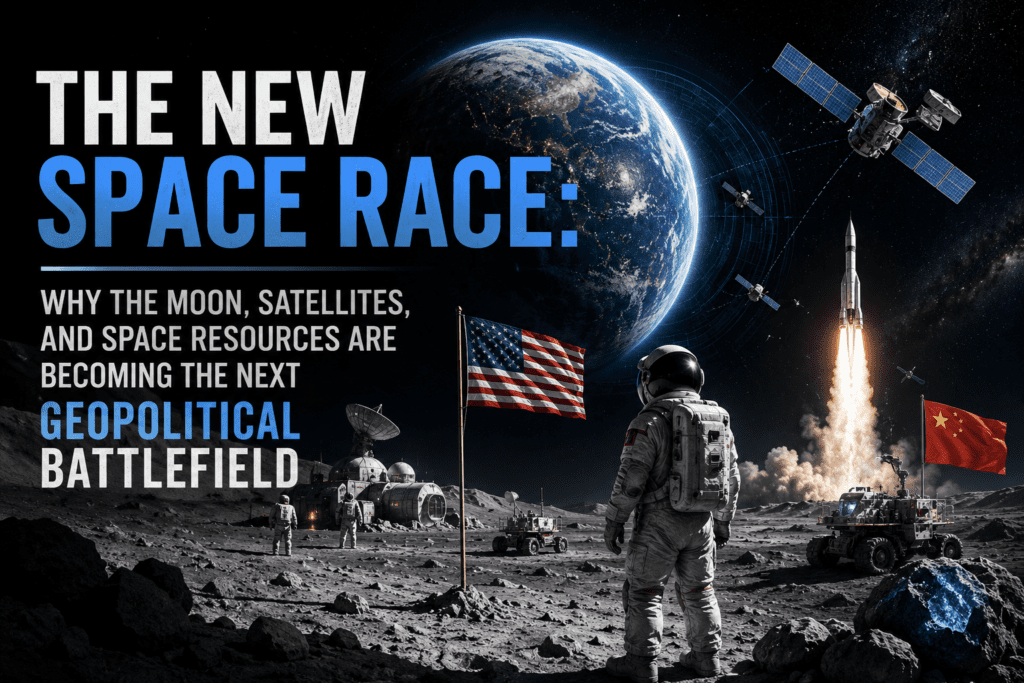
The New Space Race: Why the Moon, Satellites, and Space Resources Are Becoming the Next Geopolitical Battlefield
Introduction
The space race is back, but this time it is not only about planting flags on the Moon. The new space race is about satellites, lunar bases, space resources, military power, communication networks, and global influence.
During the Cold War, the United States and the Soviet Union competed to prove technological superiority. Today, the competition is wider. The United States, China, Europe, Russia, India, Japan, and private companies are all trying to shape the future of space.
The Moon is no longer seen as a distant rock. It is being viewed as a strategic location for science, resources, communication, and future deep-space missions. Satellites are no longer only used for weather or television. They are now essential for internet access, GPS, banking, defense, agriculture, disaster response, and military operations.
Space has become a geopolitical battlefield.
Why the New Space Race Is Different
The old space race was mostly between two superpowers. The new space race includes governments, private companies, military agencies, and commercial investors.
Companies like SpaceX, Blue Origin, Rocket Lab, and many satellite startups have changed the economics of space. Launch costs have fallen, satellite networks are expanding, and governments are relying more on private firms.
At the same time, China has built its own powerful space program, including the Tiangong space station, lunar missions, Mars missions, and plans for a crewed Moon landing. Reuters reported in May 2026 that China launched the Shenzhou-23 mission, supporting its goal of a crewed Moon landing by 2030.
This makes the space race more complex than before. It is not only America versus China. It is a competition between different space ecosystems.
The Moon Is Becoming Strategic Again
For decades, many people thought the Moon was only important for science. Now, governments see it as a strategic platform.
The Moon can support research into geology, astronomy, radiation, and deep-space survival. It may also contain water ice in permanently shadowed craters near the lunar south pole. Water ice is important because it could support astronauts, produce oxygen, and potentially create rocket fuel.
This is why the lunar south pole has become a focus of global attention.
NASA says Artemis IV astronauts will travel to lunar orbit, with two crew members descending to the lunar surface and spending about a week near the Moon’s south pole. NASA also says it continues to target early 2028 for the first Artemis lunar landing.
China is also moving fast. Its 2030 crewed Moon landing goal and long-term lunar base ambitions show that the Moon is becoming a major arena of power.
Artemis Accords vs China-Led Space Partnerships
The new space race is also about rules.
The United States is building global cooperation through the Artemis Accords, a set of principles for peaceful and responsible space exploration. NASA says Paraguay became the 67th nation to sign the Artemis Accords on May 7, 2026.
China and Russia, meanwhile, have promoted the International Lunar Research Station concept. This creates two broad visions for lunar governance: one led by the US and its partners, and another led by China and Russia.
The question is not only who lands first. The bigger question is: whose rules will define the Moon?
Satellites: The Invisible Backbone of Earth
Most people do not think about satellites every day, but modern life depends on them.
Satellites power GPS navigation, military communication, internet connectivity, weather forecasting, financial timing systems, emergency response, border monitoring, and global broadcasting.
If satellites fail, economies can be disrupted. Flights, shipping, banking, agriculture, and defense systems may suffer.
This is why satellite networks are now a national security priority. Countries are building more satellites, anti-satellite defenses, space tracking systems, and resilient communication networks.
The Stanford Emerging Technology Review notes that dramatic increases in satellites, debris, and geopolitical competition will require new technologies and policy frameworks to manage space traffic, avoid conflict, and protect space as a global commons.
Space Debris: A Growing Danger
As more satellites are launched, space debris becomes a serious problem. Even a tiny piece of debris can damage or destroy a satellite because objects travel at extremely high speeds in orbit.
If collisions increase, some orbits could become dangerous. This would affect communication, Earth observation, scientific missions, and military systems.
Space debris is not only a technical issue. It is a geopolitical issue. If one country’s satellite breaks apart and creates debris, it can threaten everyone’s satellites.
That is why space traffic management will become one of the most important policy debates of the next decade.
Space Resources and Moon Mining
The idea of mining the Moon sounds like science fiction, but governments and companies are already thinking about it.
Potential space resources include water ice, helium-3, rare metals, and materials for building space infrastructure. The real value may not be bringing everything back to Earth. It may be using space resources in space.
For example, water ice could support astronauts or be converted into fuel. Lunar soil could be used for construction. Space-based manufacturing could reduce the need to launch everything from Earth.
But this raises legal and political questions. Who owns lunar resources? Can a company mine the Moon? Can a country claim a resource zone? What happens if two missions want the same location?
These questions are still not fully settled.
India’s Role in the New Space Race
India is becoming a serious space power. The success of Chandrayaan-3 made India the first country to land near the lunar south pole region. India’s low-cost space model, growing private space sector, and future human spaceflight plans make it an important player.
India can benefit from satellite services, space startups, launch services, climate monitoring, defense applications, and lunar science. It can also become a trusted partner for countries that want affordable access to space.
For India, the new space race is not only about prestige. It is about technology, security, business, and strategic independence.
Why Space Is a Military Battlefield
Space is deeply connected to military power. Armies depend on satellites for navigation, targeting, communication, surveillance, and missile detection.
If a country can disrupt enemy satellites, it can weaken military operations. That is why anti-satellite weapons, electronic warfare, jamming, cyberattacks, and satellite resilience are becoming major concerns.
Future wars may not begin in space, but space systems will likely influence how wars are fought on Earth.
The Role of Private Companies
Private companies are changing the speed of the space race. Governments used to build almost everything themselves. Now, they increasingly depend on commercial launch providers, satellite companies, lunar lander firms, and space communication networks.
This creates innovation, but also risk. If national security depends on private companies, governments must think carefully about regulation, contracts, cybersecurity, and crisis management.
The future of space will be public-private.
Conclusion
The new space race is not just about reaching the Moon. It is about controlling the infrastructure of the future.
Satellites control communication. Lunar missions shape scientific and strategic influence. Space resources could support future industry. Military systems depend on orbital networks. Private companies are accelerating everything.
Space is becoming the next geopolitical battlefield because it connects technology, defense, economics, and global power.
The country that leads in space will not only explore the universe. It may also shape the future of Earth.
FAQs
What is the new space race?
The new space race is the modern competition between countries and companies for Moon missions, satellites, space resources, and orbital power.
Why is the Moon important again?
The Moon may support science, future bases, water ice extraction, deep-space missions, and strategic influence.
Are satellites part of geopolitics?
Yes. Satellites support GPS, internet, banking, defense, weather forecasting, and military communication.
Which countries are leading the space race?
The United States, China, India, Europe, Russia, and Japan are major players, along with private companies