
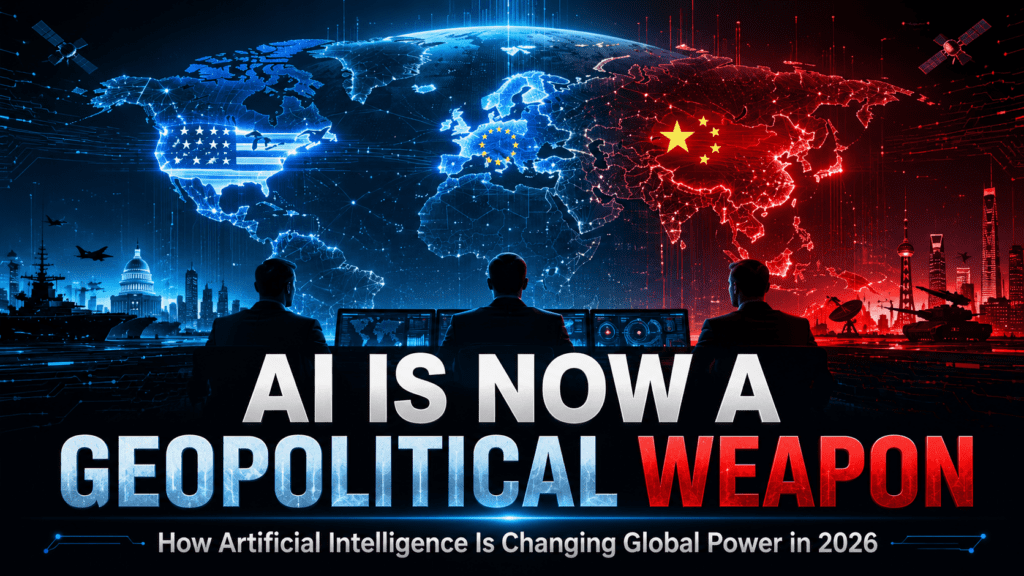
AI Is Now a Geopolitical Weapon: How Artificial Intelligence Is Changing Global Power in 2026
Introduction
Artificial intelligence is no longer just a business tool. It is becoming a weapon of influence, power, and control. In 2026, AI is shaping how countries compete, how armies prepare, how economies grow, and how information spreads online.
Earlier, global power depended mostly on oil, military strength, nuclear weapons, trade routes, and financial systems. Today, a new layer has been added: AI capability. Countries that control advanced AI models, chips, data centers, cloud infrastructure, and AI talent can influence the future of global politics.
The United States, China, and Europe are not only building AI companies. They are building AI power blocs. The US is pushing AI exports and chip leadership, China is building domestic AI ecosystems, and Europe is focusing on regulation, safety, and trusted AI systems. The White House described AI as a foundational technology that will define future economic growth, national security, and global competitiveness.
This is why AI is now one of the most important geopolitical weapons of the modern world.
What Does “AI as a Geopolitical Weapon” Mean?
AI as a geopolitical weapon does not only mean killer robots or military drones. It means using artificial intelligence to gain strategic advantage.
AI can help a country:
Improve cyber defense
Build smarter weapons
Control information narratives
Predict economic risks
Boost manufacturing
Automate intelligence analysis
Influence elections and public opinion
Strengthen surveillance systems
Speed up scientific discovery
Dominate global technology markets
This makes AI more than software. It becomes a tool of national power.
The US-China AI Race
The biggest AI rivalry today is between the United States and China. The US has major advantages in advanced chips, frontier AI models, cloud platforms, and research universities. China has massive data ecosystems, strong manufacturing capacity, government-backed AI planning, and fast-growing domestic chip efforts.
In May 2026, Reuters reported that US lawmakers introduced a bipartisan bill to counter China’s global expansion in AI and technology sales. The proposal included a new State Department office and a $500 million fund to help allied countries buy US technologies.
This shows that AI is no longer only about companies competing for users. It is about governments competing for allies.
If a country builds its digital infrastructure using Chinese AI systems, it may become dependent on China’s standards, cloud ecosystem, hardware, and security architecture. If it uses American AI systems, it becomes closer to the US technology ecosystem. This is similar to how countries once aligned around defense systems, energy suppliers, or telecom networks.
AI Exports Are the New Soft Power
AI exports are becoming a new form of diplomacy. A country can gain influence by offering AI models, cloud systems, cybersecurity tools, data centers, and automation platforms to other nations.
Reuters reported in May 2026 that the Trump administration was preparing an ExportAI Initiative using tools such as loan guarantees, direct loans, and export insurance to support foreign purchases of trusted US AI technologies.
This is important because AI infrastructure is sticky. Once a government or company builds systems on a particular AI stack, it becomes difficult to move away. Training, integrations, data pipelines, APIs, compliance systems, and business workflows all become connected.
That means AI exports can create long-term influence.
AI Chips: The Real Battlefield
AI models need chips. Without advanced GPUs and AI accelerators, it is difficult to train large models or run powerful AI systems at scale. That is why AI chip export controls have become a central part of geopolitics.
The fight is not only about who builds the best chatbot. It is about who can access enough compute power to train the next generation of AI.
Advanced chips are used for language models, image generation, scientific research, defense simulations, autonomous systems, and cybersecurity. Countries that cannot access chips may fall behind in AI development. Countries that control chip supply can shape who gets to compete.
Europe’s Strategy: Regulation as Power
Europe may not have the same number of frontier AI companies as the US or China, but it has another weapon: regulation.
The EU AI Act entered into force on August 1, 2024, and becomes fully applicable on August 2, 2026, with some exceptions. The law creates a risk-based framework for AI systems, covering areas such as prohibited AI practices, high-risk AI, transparency, and governance.
This matters because European regulation often influences global companies. If a business wants access to the European market, it may adjust its AI systems to meet EU standards. Over time, these standards can become global norms.
So Europe’s AI power is not only in building models. It is in shaping the rules of trustworthy AI.
AI and Military Power
AI is already changing defense strategy. Modern militaries are exploring AI for surveillance, drone coordination, cyber operations, logistics, threat detection, battlefield analysis, and autonomous systems.
AI can process satellite images faster than humans. It can detect unusual troop movement, identify cyberattacks, and support decision-making. However, this also creates risk. If AI systems are unreliable, biased, hacked, or used without human control, they can create dangerous mistakes.
This is why the military use of AI is becoming one of the most sensitive global issues.
AI and Information Warfare
One of the biggest dangers of AI is not physical war, but information war.
AI can generate fake images, fake videos, fake voices, fake news articles, and fake social media accounts at massive scale. This can be used to influence elections, damage reputations, spread propaganda, or create confusion during conflict.
In the past, propaganda required large teams. Now, one person with AI tools can create thousands of convincing messages. This makes truth harder to protect.
Governments are now worried not only about cyberattacks, but also about AI-powered psychological operations.
AI and Economic Dominance
AI can increase productivity in coding, design, marketing, logistics, research, finance, education, healthcare, and manufacturing. Countries that adopt AI faster can grow faster.
But there is a risk: AI may increase inequality between nations. Rich countries with chips, data centers, talent, and capital will move faster. Poorer countries may become dependent on foreign AI platforms.
This could create a new form of digital colonialism, where developing countries use AI tools controlled by foreign companies and governments.
What This Means for India
India has a major opportunity in the AI era. It has a large digital population, strong software talent, startup energy, and growing demand for automation. India can become a major AI services, AI application, and AI governance hub.
But India must focus on compute infrastructure, local-language AI, cybersecurity, data protection, AI education, and domestic model development. If India only consumes foreign AI tools, it may miss the bigger opportunity.
The future belongs to countries that can build, regulate, and export AI.
Conclusion
AI is now a geopolitical weapon because it controls information, productivity, military intelligence, cyber power, economic growth, and global influence.
The countries that lead in AI will not only build better apps. They will shape the future of work, security, trade, education, and democracy.
In 2026, the AI race is no longer a technology race alone. It is a global power race. The question is not whether AI will change geopolitics. It already has.
The real question is: who will control the AI systems that control the world?
FAQs
Why is AI important in geopolitics?
AI affects military power, economic growth, cyber defense, propaganda, surveillance, and global technology leadership.
Which countries are leading the AI race?
The United States and China are the main competitors, while Europe is shaping global AI rules through regulation.
How is AI used as a weapon?
AI can be used in cyberattacks, drones, surveillance, propaganda, military planning, and economic competition.
What is the EU AI Act?
The EU AI Act is a major AI regulation framework that sets rules based on the risk level of AI systems.