
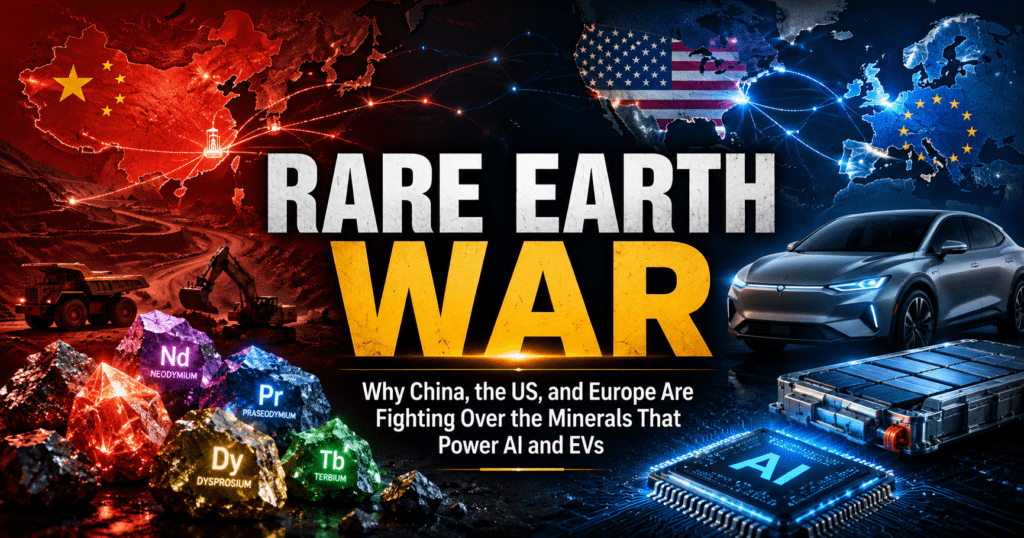
Rare Earth War: Why China, the US, and Europe Are Fighting Over the Minerals That Power AI and EVs
Introduction
The next global conflict may not begin with oil, gas, or land. It may begin with tiny minerals hidden inside electric vehicles, smartphones, wind turbines, satellites, fighter jets, and AI data centers. These minerals are called rare earth elements, and they are now at the center of a new economic and geopolitical war.
Rare earth minerals are not always “rare” in the ground, but they are difficult, expensive, and environmentally sensitive to mine, refine, and process. That is why the real power is not only in owning the minerals, but in controlling the supply chain. Today, China has a powerful advantage because it dominates rare earth processing and magnet manufacturing. According to the International Energy Agency, China’s share of sintered permanent magnet production reached 94% in 2024, making it a major force in the global clean technology and defense supply chain.
This is why the United States, Europe, Japan, India, and Australia are now racing to secure rare earth minerals. Whoever controls these minerals can influence the future of AI chips, electric vehicles, renewable energy, defense systems, and advanced manufacturing.
What Are Rare Earth Minerals?
Rare earth elements are a group of 17 metallic elements used in high-performance technologies. Some of the most important names include neodymium, dysprosium, terbium, yttrium, scandium, and praseodymium.
These minerals are used to make powerful permanent magnets. These magnets are essential for EV motors, wind turbines, drones, robotics, medical machines, advanced sensors, and military equipment. Without them, many modern technologies become less efficient, more expensive, or harder to produce at scale.
The rare earth war is not just about mining. It is about refining, processing, magnet production, and export control. A country may have rare earth deposits, but if it cannot process them into high-grade materials, it still depends on foreign suppliers.
Why China Has So Much Power
China spent decades building its rare earth industry. It invested in mining, chemical processing, refining, magnet manufacturing, and export networks. While many Western countries avoided rare earth processing because of pollution concerns and low profit margins, China built a complete industrial chain.
That decision now gives China a strategic advantage. In April 2025, China introduced export controls on seven heavy rare earth elements, related compounds, and magnets. The IEA reported that export volumes dropped sharply in April and May, creating supply problems for automakers in the United States, Europe, and other regions. Some companies faced reduced production or temporary shutdown risks because they could not source enough permanent magnets.
In simple words, China does not need to stop exporting everything. Even a delay in licenses, paperwork, or magnet shipments can pressure global companies.
Why Rare Earths Matter for AI
When people think about AI, they usually think about software, data, and chips. But AI also depends on physical infrastructure: data centers, cooling systems, servers, power grids, semiconductors, and advanced electronics. Rare earths and other critical minerals support this hardware ecosystem.
AI needs powerful chips, but chips need stable supply chains. Semiconductor tools, high-performance sensors, lasers, and advanced cooling systems often depend on critical minerals. If mineral supply becomes unstable, AI infrastructure becomes more expensive.
That is why rare earths are not only an EV issue. They are also part of the AI supply chain war. The country that controls minerals can indirectly influence chip production, defense AI, robotics, and cloud infrastructure.
Why EVs Depend on Rare Earths
Electric vehicles are one of the biggest reasons rare earth demand is rising. Many EV motors use permanent magnets made with rare earth elements. These magnets help motors become smaller, lighter, and more efficient.
As the world moves toward electric mobility, demand for rare earths is increasing. The IEA said demand for rare earths grew by 6–8% in 2024, driven largely by electric vehicles, battery storage, renewables, and grid networks.
This creates a serious question: how can countries promote EV adoption if they depend heavily on one country for key materials?
Europe’s Response: Critical Raw Materials Act
Europe has understood the danger of overdependence. The EU’s Critical Raw Materials Act sets clear 2030 targets: at least 10% of annual consumption from EU extraction, 40% from EU processing, 25% from recycling, and no more than 65% dependency on a single third country for any strategic raw material.
This is a major shift. Europe is no longer treating minerals as only a business issue. It is treating them as a national security and industrial survival issue.
But Europe faces challenges. Mining projects take years. Local communities often oppose mining because of environmental risks. Processing plants require money, technology, permits, and skilled workers. Recycling rare earth magnets is promising, but it is still not enough to meet future demand.
America’s Rare Earth Problem
The United States wants to reduce its dependence on China, especially for defense and technology. Rare earths are used in missiles, aircraft, radar systems, submarines, drones, and communication equipment. If supply is disrupted, defense production can be affected.
In May 2026, Reuters reported that China said it would cooperate with the US on “reasonable” concerns related to rare earth export controls, while still defending its restrictions as lawful. The same report noted concerns around minerals such as yttrium and scandium, which are important for aerospace and advanced technologies.
This shows the real problem. Even when countries negotiate, rare earth exports remain a powerful bargaining tool.
Is This the New Oil War?
In the 20th century, oil shaped global politics. Countries fought for access to oil fields, shipping routes, and energy security. In the 21st century, critical minerals may play a similar role.
Rare earths are not replacing oil completely, but they are becoming essential for the technologies that will define the future: AI, EVs, clean energy, defense, satellites, and robotics.
The rare earth war is not only about who has minerals. It is about who controls the full chain: mining, processing, refining, magnet production, patents, export rules, and recycling.
What This Means for India
India has a major opportunity. As global companies look for alternatives to China, India can build capacity in mining, refining, electronics manufacturing, EV supply chains, and rare earth recycling.
But India must move fast. It needs better mineral exploration, cleaner processing technology, public-private partnerships, and skilled talent. If India can build a reliable rare earth ecosystem, it can become a key player in the global supply chain.
Conclusion
The rare earth war is not a future possibility. It is already happening. China, the US, and Europe are fighting for control over the minerals that power AI, EVs, clean energy, and defense.
For ordinary people, this may sound like a distant issue. But it can affect car prices, smartphone costs, defense security, renewable energy projects, and even the speed of AI development.
The world is entering a new era where minerals are power. The countries that secure rare earth supply chains today may dominate the technologies of tomorrow.
FAQs
What are rare earth minerals used for?
Rare earth minerals are used in EV motors, wind turbines, smartphones, satellites, defense systems, medical devices, and AI-related hardware.
Why does China control rare earths?
China built a strong supply chain in mining, refining, processing, and magnet manufacturing over several decades.
Are rare earths important for AI?
Yes. AI depends on chips, data centers, electronics, sensors, and power systems that use critical minerals.
Can Europe and the US reduce dependence on China?
Yes, but it will take years of investment in mining, processing, recycling, and alternative supply chains.