
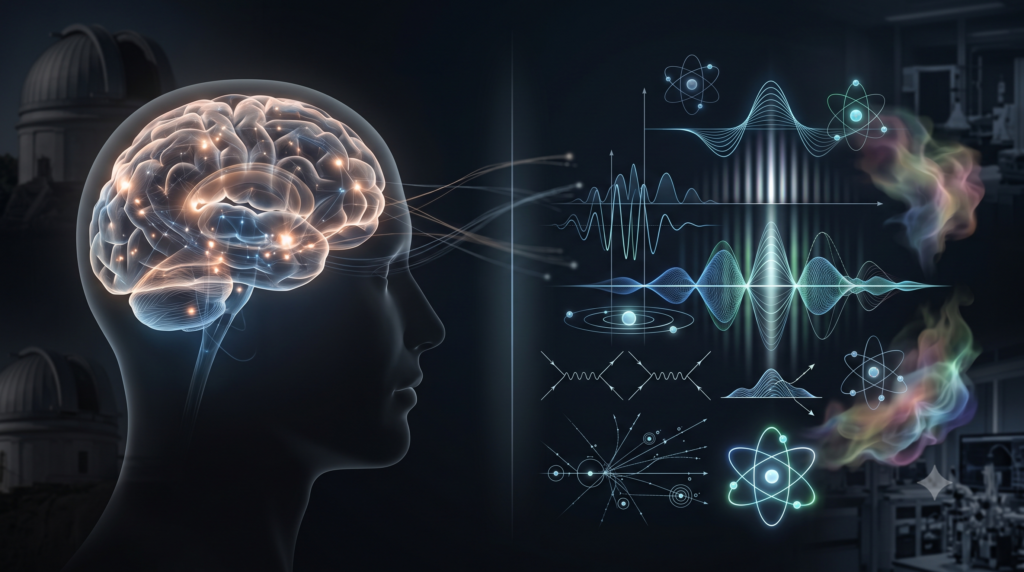
Does Quantum Physics Really Support Consciousness? Separating Science from Spiritual Claims
Does quantum physics prove that consciousness creates reality? No. Modern quantum mechanics contains genuinely strange phenomena—superposition, entanglement, uncertainty and measurement—but none of them currently establishes that human consciousness is required to produce physical reality. A few scientific hypotheses explore possible quantum effects in the brain, while many spiritual claims go far beyond the available evidence.
The question remains fascinating because it sits at the border of physics, neuroscience and philosophy. To understand it properly, we need to separate three things that are often mixed together: what quantum physics experimentally demonstrates, what theories of consciousness propose, and what spiritual interpretations add on top.
Why Quantum Physics and Consciousness Are Often Linked
Quantum mechanics transformed our picture of nature. At microscopic scales, particles cannot always be described as tiny objects with definite properties before measurement. Instead, the theory uses a mathematical wave function that predicts probabilities for possible outcomes.
This language has inspired a popular idea: if a measurement changes what can be observed, perhaps a conscious observer is somehow creating reality. That sounds profound—but it is not what most physicists mean by “observer.” In quantum theory, an observer can simply mean a physical measuring interaction or apparatus. A detector can register an event whether or not a person is looking at it at that moment.
If you want a simple foundation first, read our guide Quantum Physics in Simple Words.
What the Measurement Problem Actually Is
The measurement problem asks how the range of possibilities described by a quantum state becomes the definite outcome we observe. Different interpretations answer this differently.
- Copenhagen-style interpretations treat measurement as the point at which the formal description changes from possibilities to an outcome.
- Many-worlds interpretations avoid a unique collapse by describing all outcomes as branches of the universal wave function.
- Objective-collapse theories propose that collapse is a physical process that can occur without consciousness.
- Decoherence explains how interactions with the environment rapidly suppress observable quantum interference in large systems, although philosophers still debate whether decoherence alone solves every conceptual part of the measurement problem.
The key point is that the existence of a measurement problem does not itself prove a special role for consciousness.
Did Early Quantum Physicists Say Consciousness Causes Collapse?
Some historical discussions did connect measurement with mind. Physicists and philosophers such as John von Neumann and Eugene Wigner are often cited in debates about whether consciousness completes the measurement process.
But historical interest is not the same as modern experimental confirmation. Physics has developed powerful ways to describe measurement, open quantum systems and decoherence without requiring a human mind as a basic ingredient.
So the statement “quantum physics says consciousness collapses the wave function” is too strong. It is better described as one philosophical interpretation that has been discussed, not an established result of quantum mechanics.
What Is Quantum Consciousness?
“Quantum consciousness” is an umbrella term for proposals suggesting that quantum processes play a functionally important role in conscious experience. These ideas vary widely in seriousness.
At one end are scientific hypotheses that make claims about brain biology. At the other are broad claims that thoughts directly influence distant matter, the universe responds to intention, or awareness exists outside the brain because quantum entanglement exists. Those latter claims usually lack a demonstrated physical mechanism and should not be treated as established science.
Orch-OR: The Best-Known Quantum Theory of Consciousness
The most famous scientific proposal is Orchestrated Objective Reduction (Orch-OR), associated with physicist Roger Penrose and anesthesiologist Stuart Hameroff.
The theory proposes that quantum processes inside microscopic structures called microtubules, which form part of the cell’s cytoskeleton, may contribute to conscious moments. Penrose also proposed that quantum-state reduction may involve a deeper physical process related to spacetime or gravity.
Orch-OR is scientifically interesting because it tries to connect consciousness to specific biological structures and physical processes. However, it remains controversial and has not become the consensus explanation of consciousness.
One major challenge is maintaining delicate quantum coherence inside the warm, wet and noisy environment of the brain. Physicist Max Tegmark famously estimated extremely short decoherence times for certain proposed neural quantum states. Supporters of Orch-OR dispute whether those calculations apply to the relevant mechanisms, so the debate remains open at the level of hypothesis—not proof.
Does the Brain Use Quantum Effects at All?
Quantum effects certainly matter in biology at the molecular level because chemistry itself is quantum mechanical. Researchers have also investigated potentially useful quantum phenomena in areas such as photosynthesis, enzyme reactions and animal magnetoreception.
But there is an important distinction between:
- quantum mechanics being necessary to explain molecules in the brain, and
- large-scale, long-lived quantum coherence being necessary for conscious experience.
The first statement is uncontroversial. The second remains speculative.
What Neuroscience Says About Consciousness
Mainstream consciousness research usually investigates neural activity at the level of networks, information processing and brain-wide coordination. Leading families of theories include Global Workspace approaches, Integrated Information Theory, recurrent-processing theories and higher-order theories.
Researchers compare these models using brain imaging, electrophysiology, anesthesia, sleep studies, brain injuries and experiments that manipulate perception.
None of these approaches requires quantum consciousness, although a future theory could in principle incorporate quantum-level biology if compelling evidence emerges.
The Observer Effect Is Not “Your Mind Creates Reality”
This is one of the most common misunderstandings.
In physics, observing a system normally means interacting with it in a way that extracts information. That interaction can change the system. A photon detector, magnetic field, measuring device or environment can play this role.
The observer effect therefore does not mean that positive thinking or focused attention can freely choose physical outcomes. Quantum experiments produce statistical patterns governed by precise mathematical rules, not by the wishes of the experimenter.
What About the Double-Slit Experiment?
The double-slit experiment is often presented online as proof that particles “know when humans are watching.” That is misleading.
When information about which path a quantum object took becomes physically available, interference can disappear. This occurs because the experimental setup changes the quantum correlations and available information. Human awareness of the result is not required.
A detector can record which-path information and alter the interference pattern even if nobody checks the data until much later.
Entanglement Does Not Prove Universal Consciousness
Quantum entanglement creates correlations between systems that cannot be explained by ordinary classical local variables. It is one of the most experimentally confirmed features of quantum physics.
But entanglement does not demonstrate telepathy, a universal mind or consciousness existing outside the brain. These are additional philosophical or spiritual claims.
The leap from “nature contains nonclassical correlations” to “all minds are connected” is not a scientific deduction.
Where Spiritual Claims Enter the Discussion
Quantum physics is sometimes combined with traditions that emphasize unity, consciousness or the unreliability of ordinary perception. Philosophical comparisons can be intellectually valuable when clearly labeled as comparisons.
Problems begin when metaphor is presented as experimental evidence. Similar language does not establish identical mechanisms.
For example, a spiritual statement that reality is fundamentally interconnected may resonate poetically with entanglement, but entanglement has a precise mathematical meaning. The two should not be treated as interchangeable.
Could Consciousness Still Be Fundamental?
Possibly—but that is primarily a philosophical question at present.
Some philosophers defend panpsychism, the idea that consciousness or proto-conscious properties are fundamental features of reality. Others favor physicalism, emergentism, dualism or neutral monism.
These positions address the “hard problem” of consciousness: why and how physical processing is accompanied by subjective experience.
Quantum mechanics may eventually contribute to this debate, but it does not currently settle it. We explore the broader possibility in The Landscape of Cosmic Consciousness.
Science vs Spiritual Interpretation: A Simple Comparison
| Claim | Scientific Status |
|---|---|
| Quantum systems can exist in superpositions | Well established |
| Entanglement produces nonclassical correlations | Well established |
| Measurement affects quantum experiments | Well established |
| Human consciousness is required for wave-function collapse | Not established |
| Quantum coherence in microtubules causes consciousness | Hypothesis; debated |
| Thoughts can directly manifest external events through quantum mechanics | No established evidence |
| The universe itself is conscious | Philosophical possibility, not established physics |
Why the Question Still Matters
Dismissing every connection between quantum physics and consciousness would be premature, but accepting every mystical claim would be equally unscientific.
The productive middle ground is to ask testable questions. Can quantum states remain coherent in relevant neural structures? Do they affect cognition in ways classical models cannot explain? Can competing theories make distinct experimental predictions?
If future experiments answer yes, quantum biology could become important to consciousness science. If not, consciousness may still be explained through higher-level neural computation and organization.
Final Verdict
Quantum physics does not currently prove that consciousness creates reality, collapses wave functions or connects human minds to a universal consciousness. Quantum mechanics does reveal a world that is far stranger than classical intuition suggests, and there are legitimate scientific hypotheses about quantum effects in the brain. But those hypotheses remain under investigation.
The most responsible conclusion is therefore neither “quantum consciousness is proven” nor “it is impossible.” It is this: the scientific case remains open, while many popular spiritual claims go far beyond the evidence.
Frequently Asked Questions
Does quantum physics prove consciousness creates reality?
No. Quantum mechanics predicts how measurement outcomes behave, but it has not established that human consciousness creates physical reality.
Does consciousness collapse the wave function?
Some interpretations have proposed a special role for consciousness, but this is not the scientific consensus and has not been experimentally demonstrated as necessary.
What is Orch-OR theory?
Orchestrated Objective Reduction is a theory associated with Roger Penrose and Stuart Hameroff proposing that quantum processes in neuronal microtubules contribute to consciousness. It remains controversial.
Does the double-slit experiment prove that particles respond to human observation?
No. Physical measurement and acquisition of which-path information can change interference without requiring a conscious person to observe the result.
Can quantum entanglement explain telepathy?
There is no established scientific evidence that quantum entanglement enables telepathy or direct mind-to-mind communication.
Could consciousness be a fundamental property of the universe?
That is a serious philosophical possibility discussed in theories such as panpsychism and neutral monism, but it is not currently established by experimental physics.
Further scientific reading: Roger Penrose and Stuart Hameroff’s Orch-OR review in Physics of Life Reviews; Max Tegmark’s work on quantum decoherence in brain processes; and the Stanford Encyclopedia of Philosophy entries on consciousness and quantum mechanics.