
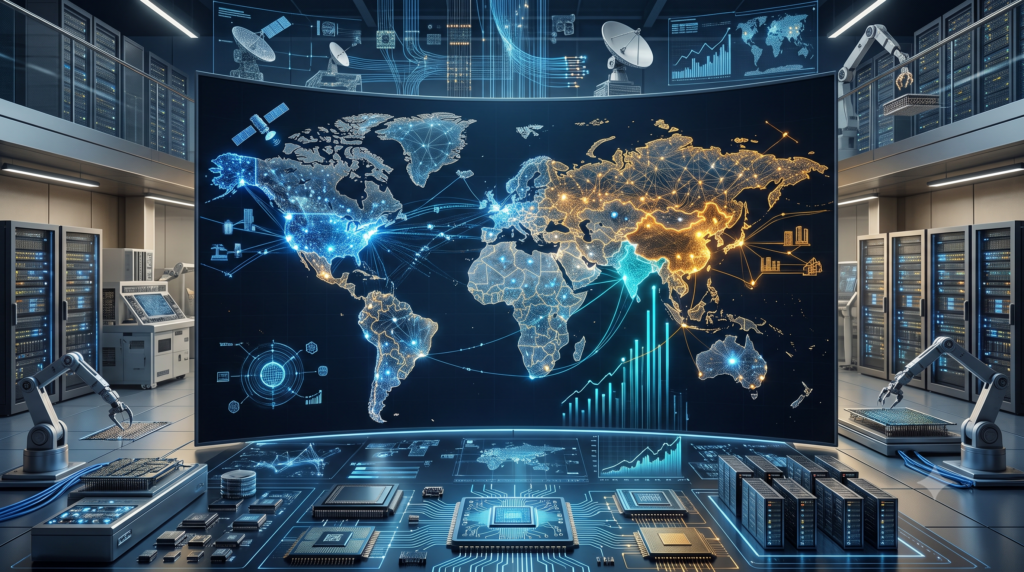
The Global AI Race: USA vs China vs India — Who Will Lead the Next Technological Era?
The global AI race in 2026 is no longer just a contest between technology companies. It is becoming a competition between nations for economic power, scientific leadership, military advantage and control over the infrastructure of the next technological era.
The United States, China and India are building three very different artificial intelligence ecosystems. The United States leads in frontier models, private investment, cloud infrastructure and many of the world’s most influential AI companies. China has become America’s closest technological challenger, combining huge research output, patent activity, manufacturing depth and increasingly competitive AI models. India remains behind both countries at the frontier, but its vast engineering base, digital public infrastructure, multilingual market and rapidly expanding sovereign AI capacity could make it one of the defining AI powers of the next decade.
So, who is winning the global AI race in 2026 — the USA, China or India?
Short answer: the United States currently leads overall, China is the closest challenger, and India is the fastest-rising large-scale contender. But the final winner may not be the country with the single smartest chatbot. Leadership will depend on who best combines chips, compute, energy, research, capital, talent, manufacturing and real-world adoption.
USA vs China vs India AI Race: The 2026 Snapshot
| Area | United States | China | India |
|---|---|---|---|
| Frontier AI models | Global leader | Very close challenger | Emerging |
| Private AI investment | Dominant | Strong, but far lower | Growing |
| AI research | World-class | Leads several volume metrics | Rapidly expanding |
| GenAI patents | High-impact ecosystem | Global volume leader | Top-five inventor location |
| Advanced chips & cloud | Major advantage | Building domestic alternatives | Early-stage but expanding |
| Manufacturing & robotics | Strong | Major advantage | Expanding |
| Talent & developers | Elite research concentration | Large domestic base | Huge engineering base |
| Multilingual AI opportunity | Moderate | Large | Exceptional |
| Current overall position | Leader | Closest challenger | Rising AI power |
Why the United States Leads the Global AI Race
If the global AI race had to be ranked today, the strongest overall position still belongs to the United States. Its advantage comes from an unusually complete ecosystem: frontier laboratories, semiconductor design, cloud platforms, hyperscale data centers, venture capital, elite universities and global software distribution.
According to the Stanford AI Index Report 2026, U.S. institutions produced 59 notable AI models in 2025, compared with 35 in China. Stanford also reports that U.S. private AI investment reached $285.9 billion in 2025, more than 23 times China’s measured $12.4 billion in private investment.
That financial advantage matters because frontier AI has become an infrastructure business. Training and serving advanced models requires huge GPU clusters, high-speed networking, electricity, cooling, data centers and teams of expensive specialists.
America’s Full-Stack AI Advantage
The United States hosts companies that influence nearly every layer of the modern AI stack, from advanced chip design and cloud computing to foundation models and consumer applications. That creates a reinforcing cycle: capital funds research, research creates products, products generate revenue, and revenue finances even larger compute systems.
The U.S. also hosts 5,427 data centers, according to Stanford’s 2026 report — more than ten times the number hosted by any other single country. That gives America an enormous infrastructure base for training and deploying AI.
China Is No Longer Simply ‘Catching Up’
The biggest change in the global AI race is that the old assumption of a large and permanent U.S. lead is becoming harder to defend.
Stanford’s 2026 AI Index concludes that the U.S.-China model performance gap has effectively closed. American and Chinese models have traded positions near the top of major rankings since early 2025. By March 2026, leading systems from U.S. companies such as Anthropic, xAI, Google and OpenAI were competing in the same top tier as Chinese systems from Alibaba and DeepSeek.
This does not mean China leads overall. It means the competition is now much closer at the frontier than it was only a few years ago.
China’s Research and Patent Strength
China’s advantages extend far beyond model benchmarks. Stanford reports that China leads in AI publication volume, citations and patent grants, although the United States retains an advantage in higher-impact patents.
Patent data also shows the scale of China’s innovation system. The World Intellectual Property Organization found that inventors based in China were responsible for more than 38,000 generative-AI patent families between 2014 and 2023, compared with about 6,300 in the United States. India ranked fifth among inventor locations in that dataset.
WIPO’s 2026 update also found that global GenAI patenting accelerated dramatically, with more new patent families published in 2024 and 2025 combined than in the entire preceding decade.
China’s Hidden Advantage: Manufacturing and Robotics
AI is moving from screens into the physical world. Intelligent factories, autonomous vehicles, drones, industrial robots and humanoid systems could become as strategically important as chatbots.
That shift potentially favors China because it already possesses one of the deepest manufacturing ecosystems on Earth. If the next phase of AI is defined by physical AI rather than purely digital assistants, China’s ability to combine software with industrial production could become a major geopolitical advantage.
Where India Stands in the AI Race
India is not yet operating at the same frontier-model or capital scale as the United States and China. But describing India simply as ‘third place’ misses what makes its AI trajectory important.
India brings a different combination of assets: a vast engineering workforce, a large software-services industry, more than a billion potential users, multilingual demand, digital public infrastructure, a growing startup ecosystem and an increasingly serious sovereign-AI program.
The Government of India’s IndiaAI Mission had expanded shared compute capacity to more than 45,000 GPUs by June 2026. By August 2026, 237 projects had accessed subsidized compute covering 93.18 lakh GPU hours. The government had also selected 20 indigenous foundation-model proposals, including 12 large multimodal models and eight small language models.
India’s Biggest Opportunity: AI at Population Scale
India does not necessarily need to copy Silicon Valley to become an AI superpower. Its strongest opportunity may be building affordable AI for real-world problems across healthcare, education, agriculture, financial services, public administration, logistics and small businesses.
In July 2026, India’s Press Information Bureau reported that the IndiaAI Mission had identified 762 AI use cases across 62 ministries, while approving 58 AI Centres of Excellence and 543 Data & AI Labs.
If AI becomes a utility used by hundreds of millions of ordinary people, India’s ability to test and deploy systems at enormous scale could become a strategic advantage of its own.
Multilingual AI Could Be India’s Secret Weapon
Much of the global AI industry was initially built around English. India presents a much harder — and potentially more valuable — challenge: making AI useful across Hindi, Bengali, Tamil, Telugu, Marathi, Gujarati, Kannada, Malayalam and many other languages and dialects.
Solving multilingual speech, translation, education, government-service and commerce problems at Indian scale could create technologies that are useful across Asia, Africa and other linguistically diverse markets.
The Semiconductor and Energy Race Behind AI
The global AI race is ultimately constrained by physical infrastructure. The most powerful models require advanced chips, fabrication capacity, data centers and enormous amounts of electricity.
This is why semiconductors have become one of the world’s most strategic resources. The U.S. remains exceptionally strong in advanced chip design and AI computing platforms, while China is investing heavily in technological self-sufficiency and India is attempting to build a larger domestic semiconductor ecosystem. For the wider supply-chain battle behind AI hardware, read Rare Earth War: Why China, the US, and Europe Are Fighting Over the Minerals That Power AI and EVs.
Energy may become just as decisive. America’s AI Action Plan explicitly connects AI leadership with faster construction of data centers, semiconductor facilities and new energy infrastructure.
In other words, the future of artificial intelligence may depend as much on power plants and chip fabs as on algorithms.
Who Is Winning the AI Race in 2026?
1. United States — Overall Leader
The U.S. currently has the strongest combination of frontier models, private capital, cloud computing, data centers, chip design and globally influential AI companies. Its ecosystem remains the benchmark the rest of the world is trying to match.
2. China — Closest Challenger
China has narrowed the model-performance gap dramatically while building enormous strength in research, patents, robotics and manufacturing. It may be especially well positioned if AI increasingly shifts toward factories, autonomous systems and physical machines.
3. India — Emerging AI Giant
India is behind the two leaders at the frontier, but its growth should not be underestimated. Its long-term advantage could come from talent, multilingual AI, sovereign compute and population-scale deployment rather than from trying to win every benchmark immediately.
Who Could Lead AI by 2030?
A single winner is not inevitable. The most realistic outcome may be a multipolar AI world.
- United States: frontier models, cloud platforms, advanced computing and high-value AI companies.
- China: industrial AI, robotics, manufacturing automation and large-scale deployment.
- India: affordable AI, multilingual systems, software integration and population-scale applications.
The country that dominates only one layer of AI will remain dependent on others. Long-term power will come from controlling multiple layers of the stack: energy → semiconductors → compute → models → applications → robotics → users.
Can India Overtake China or the USA?
It is possible, but not automatic. India would need sustained progress in fundamental research, advanced computing, semiconductor capabilities, globally competitive foundation models, deep-tech startups and the retention of top research talent.
The bigger opportunity may be to define a different form of AI leadership: becoming the world’s most important test bed for practical, affordable, multilingual AI.
Why the Global AI Race Matters to Everyone
The consequences of AI leadership will extend far beyond technology stocks. The countries that shape AI could influence future jobs, education, healthcare, cybersecurity, military systems, scientific discovery, manufacturing productivity and even how billions of people access information.
AI is therefore beginning to look less like a conventional software market and more like a foundational technology comparable to electricity, computing or the internet.
For a deeper look at the geopolitical dimension, read our related analysis: AI Is Now a Geopolitical Weapon: How Artificial Intelligence Is Changing Global Power in 2026.
Final Verdict: USA vs China vs India
As of 2026, the United States leads the global AI race. China is its strongest challenger. India is building the foundations to become a major third AI power.
But the race is still early. America’s advantage is capital and frontier technology. China’s advantage is scale, research and manufacturing. India’s advantage is talent, diversity and deployment potential.
The real winner of the next technological era may not be the country with the smartest model. It may be the country that best combines intelligence, chips, computing, energy, manufacturing, talent, capital and adoption.
Frequently Asked Questions
Which country is leading the AI race in 2026?
The United States currently leads overall because of its frontier AI ecosystem, private investment, cloud infrastructure, data centers and semiconductor-design strength. China is the closest challenger.
Is China ahead of the USA in artificial intelligence?
China leads in several research and patent-volume measures, while the United States leads in overall private investment and produces more notable frontier models. The performance gap between leading U.S. and Chinese models has become very small.
Where does India rank in the global AI race?
India is an emerging major AI power rather than a current frontier leader on the scale of the U.S. or China. Its strengths include engineering talent, multilingual demand, digital infrastructure and rapidly expanding sovereign compute.
Can India become an AI superpower?
Yes. India’s strongest path is likely to combine greater frontier research with affordable, multilingual and population-scale AI deployment. Continued investment in chips, compute, research and globally competitive AI products will be critical.
Who will dominate artificial intelligence by 2030?
No single country may dominate every layer. The U.S. could remain strongest in frontier AI and cloud computing, China could lead important parts of industrial and physical AI, and India could become a global leader in multilingual and large-scale applied AI.