
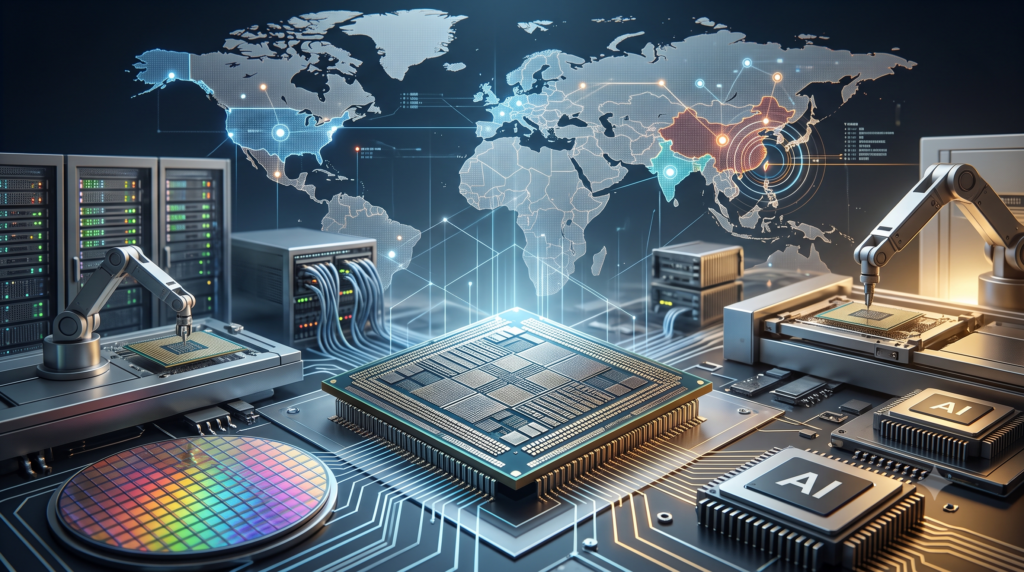
Why Semiconductors Are the World’s Most Powerful Strategic Resource
Semiconductors are the hidden foundation of the modern economy. They power smartphones, data centers, artificial intelligence, vehicles, telecom networks, satellites, medical equipment and advanced weapons. That is why chips have become more than a technology product: they are now a strategic resource that shapes economic power, military capability and geopolitical influence.
Oil powered the industrial age. Semiconductors may play a similar role in the digital age—not because they are consumed in the same way, but because almost every advanced system now depends on them.
What Is a Semiconductor?
A semiconductor is a material whose electrical conductivity can be precisely controlled. Silicon is the most common example. By arranging billions of microscopic transistors on a chip, engineers create processors capable of computation, memory, sensing and communication.
Modern chips perform different roles:
- CPUs run general computing tasks.
- GPUs process highly parallel workloads and have become essential for AI.
- Memory chips store data.
- Power semiconductors control electricity in vehicles and industrial systems.
- Analog and sensor chips connect digital systems to the physical world.
Why Chips Are More Strategic Than Most Raw Materials
A natural resource can often be replaced by another supplier if enough deposits exist. Advanced semiconductors are different because they depend on an extraordinarily complex global production network that took decades to build.
A leading-edge chip may involve design software from one country, architecture from another, manufacturing equipment from multiple specialist firms, fabrication in Taiwan or South Korea, chemicals and materials from Japan and Europe, and packaging elsewhere in Asia.
This creates a crucial reality: no major country is fully self-sufficient in the semiconductor supply chain.
AI Has Made Advanced Chips Even More Important
The artificial-intelligence boom has dramatically increased demand for high-performance computing. Training and operating large AI models requires enormous quantities of specialized accelerators, especially GPUs and related networking hardware.
This is one reason semiconductors sit at the center of the global AI race between the USA, China and India.
The country or company with reliable access to cutting-edge compute can train larger models, run more experiments and deploy AI services at greater scale. Without sufficient chips, talented researchers can still be constrained by infrastructure.
Taiwan’s Extraordinary Role
Taiwan occupies a uniquely important position because of TSMC, the world’s leading contract semiconductor manufacturer. Many of the most advanced chips designed by major technology companies are fabricated there.
This concentration creates both efficiency and geopolitical risk. Any serious disruption around Taiwan could affect electronics, cloud computing, AI and industrial production worldwide.
That is why governments increasingly treat semiconductor supply resilience as a national-security issue rather than a normal commercial concern.
Why the United States Is So Powerful in Chips
The United States retains major strengths in semiconductor design, electronic-design automation, intellectual property, AI accelerators and manufacturing equipment.
Companies based in or deeply connected to the US ecosystem play important roles across chip design and production. America’s strategic advantage is therefore not simply “making chips”; it is controlling several of the highest-value layers of the semiconductor stack.
At the same time, decades of globalization shifted a large share of fabrication capacity to Asia. US policy has increasingly focused on rebuilding domestic manufacturing while preserving leadership in design and advanced equipment.
Why China Wants Semiconductor Self-Reliance
China is one of the world’s largest markets for semiconductors and a major electronics manufacturer, but it remains dependent on foreign technology for parts of the advanced chip supply chain.
Export controls have made that dependence strategically visible. Restrictions on access to leading AI accelerators and certain chipmaking technologies have reinforced Beijing’s push for domestic alternatives.
For China, semiconductor independence is not merely an industrial goal. It affects AI, telecom, defense, consumer electronics and long-term economic sovereignty.
Where India Fits Into the Semiconductor Race
India is trying to build a larger semiconductor ecosystem through chip design, fabrication, assembly, packaging and government incentives.
India already has a substantial pool of engineers working in global semiconductor design. The harder challenge is building manufacturing capacity, supplier networks, highly specialized skills and infrastructure.
If India succeeds, semiconductors could strengthen not only domestic electronics manufacturing but also the country’s ambitions in AI, defense, telecom and industrial technology.
The Semiconductor Supply Chain Is a Geopolitical Map
The chip industry is unusually specialized. Different countries dominate different parts of the chain:
| Layer | Strategic Importance |
|---|---|
| Chip architecture and design | Determines performance and functionality |
| EDA software | Essential for designing complex chips |
| Lithography equipment | Critical for manufacturing advanced nodes |
| Wafer fabrication | Turns chip designs into physical silicon |
| Materials and chemicals | Required for highly precise manufacturing |
| Packaging and testing | Increasingly important for advanced chip systems |
This specialization creates both efficiency and vulnerability. A disruption at one critical node can affect the entire system.
Why Advanced Lithography Matters
One of the most difficult steps in chipmaking is lithography: using light to print incredibly small patterns onto silicon wafers.
Leading-edge manufacturing depends on extreme ultraviolet lithography, or EUV. The machines are among the most complex industrial systems ever built. Their scarcity illustrates why semiconductor capability cannot be created overnight simply by spending money.
Factories require equipment, expertise, process knowledge, supplier ecosystems and years of production learning.
Why Chips Matter for Military Power
Modern defense systems depend on semiconductors for radar, communications, guidance, electronic warfare, satellites, drones, cybersecurity and autonomous systems.
Military advantage increasingly depends on the ability to process information quickly and accurately. AI-enabled surveillance, targeting and decision-support systems all require computing power.
This makes advanced chips a dual-use technology: the same underlying capabilities can support commercial AI and national defense.
Cars Show Why Even “Old” Chips Matter
Not every strategically important semiconductor is a cutting-edge AI chip. The global automobile shortages of the early 2020s demonstrated that mature-node chips can also become critical bottlenecks.
Modern cars contain large numbers of semiconductors controlling engines, braking, infotainment, safety systems, sensors and power management. Electric vehicles require even more electronics.
This means semiconductor security is about more than frontier processors. A resilient economy needs access to chips across many generations and categories.
Rare Earths and Semiconductors Are Connected—but Different
Semiconductor production also depends on specialized materials, chemicals and equipment. This connects the chip race to broader competition over strategic minerals.
For more on that resource competition, read Rare Earth War: Why China, the US, and Europe Are Fighting Over the Minerals That Power AI and EVs.
However, chips are not simply another mineral resource. Their strategic value comes from combining scarce materials with some of the most advanced manufacturing knowledge on Earth.
Can Countries Become Completely Chip Independent?
Complete self-sufficiency is extremely difficult and often economically inefficient. The more realistic goal is strategic resilience: ensuring access to critical technologies, maintaining domestic capability in selected areas and avoiding dependence on a single vulnerable supplier.
This is why governments are funding new fabrication plants, supporting domestic research and forming technology alliances.
The New Geopolitics of Chips
Semiconductors now influence foreign policy in ways once associated with oil, energy and military alliances. Export controls, investment restrictions, industrial subsidies and technology partnerships are increasingly tools of geopolitical competition.
Future disputes may revolve not only around territory or natural resources, but also around who can access advanced compute.
What Comes After Silicon?
Silicon will remain dominant for years, but the industry is already evolving through chiplets, advanced packaging, 3D integration, specialized accelerators and new materials for power electronics.
As traditional transistor scaling becomes harder, competitive advantage may increasingly come from architecture, packaging, energy efficiency and system-level design.
Final Verdict
Semiconductors are the world’s most powerful strategic technology resource because they sit underneath almost every advanced capability that matters. AI, cloud computing, smartphones, vehicles, weapons, telecom and industrial automation all depend on them.
The semiconductor race is therefore not simply about who sells the most chips. It is about who controls the critical technologies, factories, equipment, talent and supply chains that power the digital world.
In the 20th century, nations worried about access to oil. In the 21st century, they increasingly worry about access to compute—and compute begins with semiconductors.
Frequently Asked Questions
Why are semiconductors so important?
They are essential components in computers, phones, vehicles, AI systems, communication networks, industrial equipment and defense technology.
Why is Taiwan important to the semiconductor industry?
Taiwan hosts TSMC, the leading contract manufacturer for many of the world’s most advanced chips, making the island a critical node in the global supply chain.
Why are the US and China competing over chips?
Advanced semiconductors influence AI, military capability, economic productivity and technological independence, so both countries view chip leadership as strategically important.
Can India become a major semiconductor power?
India has strong design talent and growing investment, but building a globally competitive manufacturing ecosystem requires sustained capital, infrastructure, suppliers and specialized expertise.
Are semiconductors more important than oil?
They serve different functions, but semiconductors are increasingly comparable to oil as a strategic input because modern economic and military systems cannot function at full capability without reliable chip supplies.