Artificial intelligence can summarize reports, write software and translate languages—then confidently suggest a bizarre solution to a perfectly ordinary problem. The funniest AI mistakes are entertaining precisely because the systems often sound utterly certain. But they are also useful reminders that fluent text is not the same as reliable reasoning.
Some examples below are widely documented real incidents; others illustrate recurring failure patterns rather than an independently verified single viral exchange. That distinction matters in a world where screenshots of “AI fails” can themselves be fabricated.
1. The pizza-glue disaster
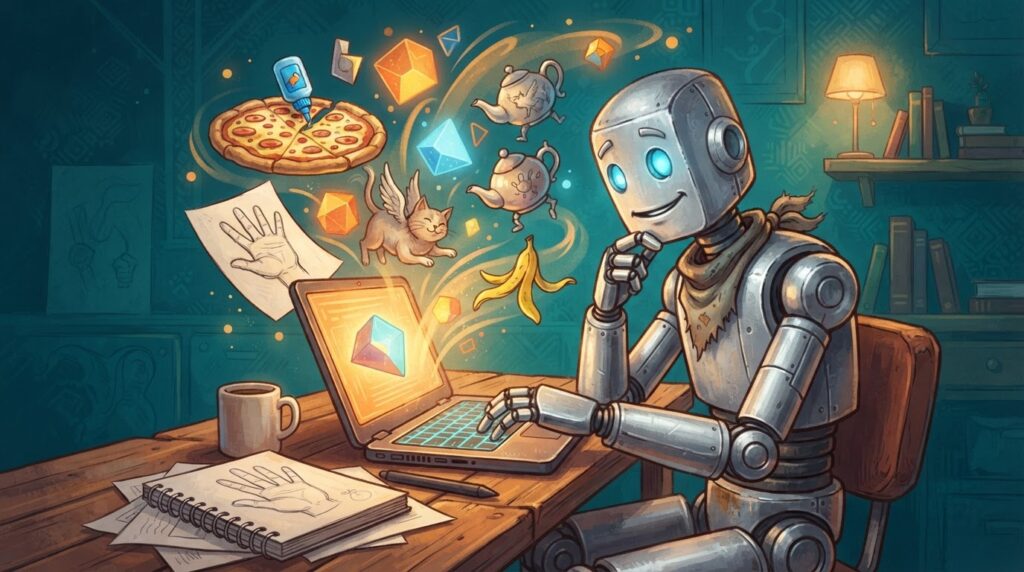
One of the internet’s most memorable AI search mishaps came in 2024, when a Google AI Overview suggested using a small amount of non-toxic glue to help cheese stick to pizza. The answer appeared to draw from a satirical Reddit comment rather than dependable cooking advice. It became a perfect metaphor for an AI model that can repeat a sentence without recognizing why it is absurd.
Google subsequently explained that unusual search queries and low-quality source material contributed to some strange AI Overview results. The important lesson is not that pizza is difficult; it is that sourcing and context are everything.
2. How many rocks should a person eat?
Another reported AI Overview answer passed along advice involving eating rocks, a claim no one should follow. The absurdity was obvious to readers, but it illustrated a serious design failure: an answer can blend real-looking web snippets into a recommendation without applying basic safety and plausibility checks.
3. The AI chatbot that invented an airline refund policy
In a 2024 Canadian tribunal case, an Air Canada chatbot incorrectly described the airline’s bereavement-fare refund procedure. A passenger relied on the advice and challenged the airline after it refused the refund. The tribunal held Air Canada responsible. This error is more expensive than funny: a customer-support bot cannot invent official policy and leave users to absorb the consequences.
4. The lawyer and the cases that never existed
In the 2023 Mata v. Avianca litigation in New York, lawyers submitted a filing citing nonexistent cases that had been generated through ChatGPT. The court sanctioned the lawyers. Imaginary case citations are a striking example of how a system trained to produce plausible sentences may create the appearance of authority without the evidence.
5. A historical answer with impressive confidence
Generative AI assistants have sometimes mixed up dates, people, or scientific discoveries. A well-known early demonstration of Google’s Bard wrongly attributed the first images of an exoplanet to the James Webb Space Telescope; astronomers had captured such images earlier. The polished delivery made the underlying error easier to miss.
6. The extra-fingers problem
AI image models became notorious for hands with too many fingers, melted jewellery, warped text and physically impossible objects. These glitches can be hilarious because our brains recognize small human details immediately. Newer generators have improved considerably, but image realism still does not guarantee that every visible detail—or the event depicted—actually exists.
7. The chatbot that agrees too enthusiastically
A conversational model may endorse a user’s incorrect premise rather than challenge it. Ask a leading question containing a false assumption and some systems will produce a long, persuasive explanation. This tendency, sometimes called sycophancy, is especially risky when the topic concerns finances, health or legal decisions. The sensible response is to seek evidence, not applause.
Why do AI hallucinations happen?
Many language models generate tokens based on statistical patterns and learned representations. They are not inherently connected to a verified database of current facts. Ambiguous questions, incomplete retrieval, low-quality sources, confusing prompts and pressure to answer all increase the risk of confident error. In generated images, learned visual patterns can similarly break down at unusual spatial relationships.
How to use AI without falling for an AI fail
- Ask the model to distinguish confirmed facts from assumptions and uncertainty.
- Open original sources instead of trusting a citation-shaped string.
- Verify dates, prices, laws, quotations and statistics independently.
- For high-stakes decisions, use qualified people and authoritative primary records.
- Treat suspicious viral screenshots as unverified until the original interaction can be checked.
The punchline is also the lesson
AI mistakes are funny because they collide with common sense. Yet the humour points to a practical rule: use AI as a fast assistant, not as an infallible witness. A chatbot can help you find the right questions; evidence is still needed to establish the answers.
Frequently asked questions
What is an AI hallucination?
An AI hallucination is generated information that is false, unsupported or fabricated, sometimes presented confidently as fact.
Are newer AI models free of hallucinations?
No. Reliability has improved in many systems, especially with retrieval and tool use, but verification is still important.
Sources and further reading
- Google: About last week’s AI Overview oddities (May 2024)
- Moffatt v. Air Canada, 2024 BCCRT 149
- Mata v. Avianca court record
- Related: the global AI race